


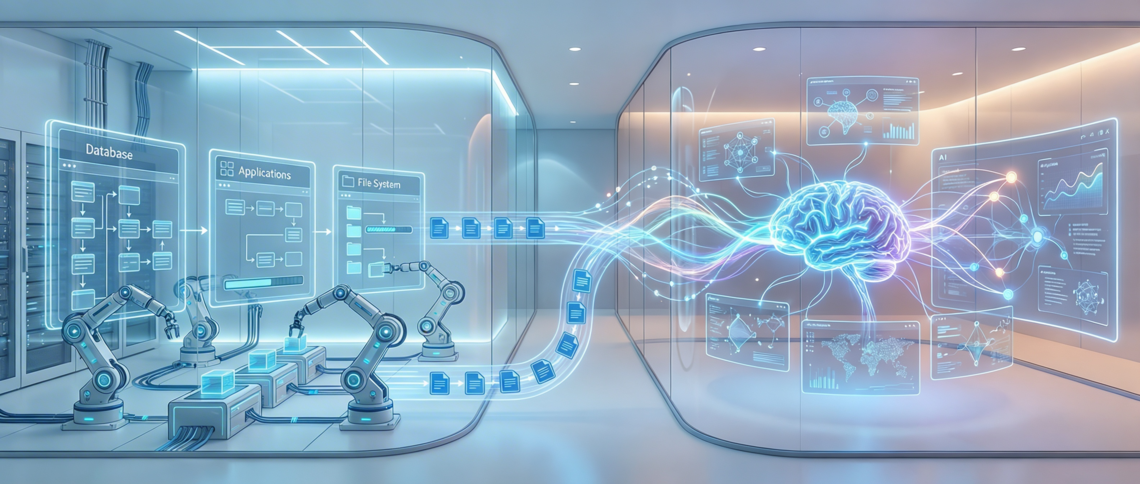
Are AI automation and RPA the same or do they serve completely different purposes in modern business operations? Automation is reshaping industries, yet the AI Automation vs RPA is often misunderstood. The core difference is clear. RPA follows predefined rules to execute repetitive tasks, while AI analyzes data, identifies patterns and continuously improves through learning. This evolution is accelerating Hyperautomation, where enterprises combine RPA, AI, analytics and process mining. Understanding the difference between AI Automation and RPA enables organizations to build a scalable enterprise automation strategy.
What is Robotic Process Automation (RPA)?
Robotic Process Automation is a rule driven automation approach that uses software bots to replicate structured and repetitive human tasks across digital systems. It focuses on task automation rather than cognitive reasoning and is ideal for standardized processes.
How RPA Works
RPA uses bots that replicate human actions on a computer screen. They log into systems, open applications, move data and complete tasks based on fixed rules. Everything runs on predefined steps. It does not learn or analyze. It simply follows instructions exactly as programmed.
Core Capabilities of RPA
RPA can log into systems, move data, fill out forms and complete routine tasks automatically. It works with structured data and follows fixed steps. Some bots assist employees during work, called attended automation. Others run on their own, known as unattended bots, to handle large volumes of repetitive tasks.
Benefits of RPA
RPA reduces human errors and keeps clear activity records for compliance. It lowers operational costs, speeds up processing and allows employees to focus on higher-value tasks. For businesses that need fast results, RPA delivers quick and measurable efficiency improvements.
Limitations of RPA
RPA cannot understand unstructured data like emails, images or scanned documents without added tools. It does not learn from experience or adjust on its own. If system screens change, bots may stop working. It also requires clearly defined rules to function properly.
What is AI Automation?
AI automation uses Artificial Intelligence to improve and automate business processes that require thinking and decision-making. Unlike RPA, which follows fixed rules, AI can analyze data, recognize patterns and make predictions. This allows businesses to automate more complex tasks and build smarter, more adaptive workflows.
What Makes AI Different?
Unlike rule-based systems, Artificial Intelligence learns from data and improves over time. It can handle unstructured inputs such as emails, documents and images. AI identifies patterns, makes predictions and adapts based on outcomes. This ability to self-improve makes it suitable for cognitive automation and intelligent workflows.
Key AI Technologies Used in Automation
AI-powered automation relies on technologies like Machine Learning, which enables systems to learn from experience. Natural Language Processing enables systems to interpret and process human language in text and voice form. Computer Vision interprets visual data. Predictive analytics and conversational AI further support forecasting and smart interactions, strengthening predictive modeling and deep learning capabilities.
Business Benefits of AI Automation
AI enhances decision intelligence by analyzing large datasets quickly. It supports fraud detection, demand forecasting, customer sentiment analysis and document understanding. By enabling intelligent insights and adaptive processes, AI-powered automation drives higher accuracy and strategic business value.
Limitations of AI
AI requires high-quality training data to function effectively. Implementation is more complex than traditional automation and demands technical expertise. Model governance, monitoring and continuous tuning are essential to maintain accuracy, compliance and long-term performance.
AI vs RPA: Key Differences Explained
Understanding the AI Automation vs RPA comparison helps leaders align automation maturity with strategic outcomes. RPA handles structured and rule-based tasks, while AI brings adaptive intelligence and data-driven decision-making into enterprise systems.
| Feature | RPA | AI Automation |
| Logic Type | Rule-based | Data-driven |
| Data Type | Structured | Structured + Unstructured |
| Learning Ability | No | Yes |
| Decision Making | Deterministic | Probabilistic |
| Complexity Handling | Low to Medium | Medium to High |
| Example | Invoice entry | Fraud detection |
Decision-Making Capability
RPA follows deterministic logic, executing predefined workflows.
AI introduces probabilistic reasoning, enabling predictive modeling and contextual decision-making. This marks the core AI vs RPA difference in intelligent automation vs automation.
Data Handling
RPA works best with structured data fields.
AI processes both structured and unstructured content, including emails, images and voice inputs. This expands automation maturity across complex enterprise environments.
Scalability & Maintenance
RPA scales through bot replication but requires updates when processes change.
AI systems scale through learning but demand governance and monitoring. Maintenance models differ significantly in enterprise automation strategy.
Implementation Complexity
RPA offers faster deployment with lower complexity.
AI automation involves data pipelines, model training and governance frameworks, making it more resource-intensive but strategically transformative.
Can AI and RPA Work Together?
Yes, and this is where competitive advantage emerges.
What is Intelligent Process Automation (IPA)?
Intelligent Process Automation combines RPA, AI and analytics for end-to-end automation. It integrates execution engines with cognitive layers to deliver seamless process orchestration.
Real-World Example, Finance Use Case
An RPA bot extracts invoice data using optical character recognition. AI validates anomalies and flags suspicious patterns. A human-in-the-loop reviews exceptions. This hybrid automation model strengthens compliance and accuracy.
When to Combine Both
Organizations should combine both for semi-structured workflows, compliance-heavy industries and customer service automation where pattern detection and rule execution must coexist within a digital workforce.
When Should Your Business Choose RPA vs AI?
Choosing the right automation between approach RPA vs artificial intelligence depends on process complexity, data variability and ROI objectives.
Choose RPA If
The process is strictly rule-based, high-volume, repetitive and structured. You need rapid ROI and quick deployment within your automation strategy.
Choose AI If
The workflow requires prediction, judgment, pattern detection or involves unstructured data. Decision variability exists and intelligent workflows are required.
Choose Both If
Enterprise workflows are complex, multi-system integration is required and the organization is scaling automation maturity within its digital transformation roadmap.
- Visual Decision Flow:
If the process is repetitive → structured → rule-driven → deploy RPA. -
If the process involves interpretation → unstructured data → predictive logic → deploy AI.
-
If both exist → implement hybrid automation through IPA.
Future of Automation: From RPA to Hyperautomation
Automation is moving beyond basic bots toward fully connected and intelligent systems. Organizations are adopting AI-driven orchestration where processes adjust in real time and decisions rely on data insights. Low-code tools and integration with Process Mining accelerate rollout and improve process visibility. As AI governance and digital workforce management mature, businesses are progressing toward autonomous operations. PIT Solutions enables this shift with future-focused hyperautomation strategies.
FAQ Section
-
Is RPA a type of AI?
No. RPA is rule-based automation that follows predefined steps to complete repetitive tasks. AI, on the other hand, learns from data and makes predictions. They are different technologies, but they can work together.
-
Which is better, AI or RPA?
It depends on your business needs. RPA is ideal for structured and repetitive processes. AI is better for tasks that require analysis, prediction or handling unstructured data. Many organizations use both for better results.
-
Is RPA being replaced by AI?
No. RPA is not being replaced. Instead, it is being enhanced by AI. Together, they form intelligent automation strategies that handle both simple and complex workflows.
-
What is intelligent automation?
Intelligent automation combines RPA with AI technologies to automate end-to-end processes. It brings together rule-based execution and intelligent decision-making within the same workflow.
-
Can small businesses use AI automation?
Yes. With cloud-based and scalable tools, small businesses can adopt AI automation to improve efficiency, reduce costs and support growth without heavy infrastructure investment.
Final Thoughts:
RPA drives execution of repetitive tasks. AI adds intelligence, learning and prediction.
Together, they build a scalable automation ecosystem for long-term growth.
Starting with the right strategy ensures clear ROI and stronger operational stability in your AI Automation vs RPA journey. PIT Solutions provides automation assessments and in-depth process audits to identify where RPA fits, where AI adds value and how both can work together. With expertise in AI and data science solutions UAE, we serve as a trusted partner for secure, scalable enterprise automation.