


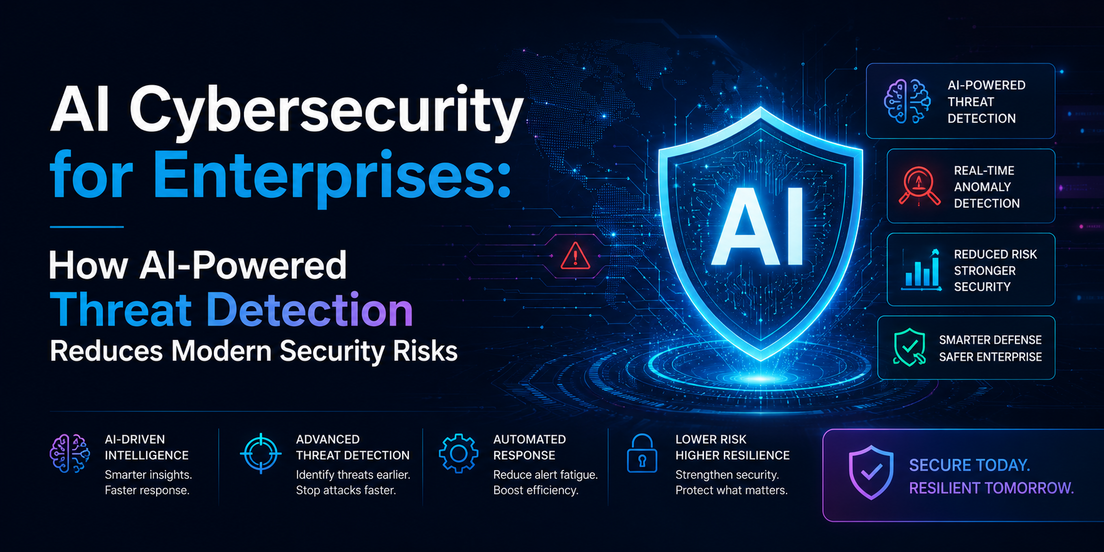
AI cybersecurity for enterprises responds to an evolving cybersecurity threat landscape where traditional security systems struggle against sophisticated attacks. With Artificial Intelligence (AI) and Machine Learning (ML), organizations enable AI-powered threat detection for real-time identification, prevention, and response to cyberattacks. This strengthens cybersecurity automation, enterprise cyber defence, intelligent threat detection, and advanced threat intelligence, positioning AI as a strategic priority for enterprises securing complex digital environments.
The Growing Complexity of Modern Enterprise Cybersecurity Threats
Digital transformation, cloud adoption, hybrid workforces, and connected IoT devices have expanded the attack surface across enterprise environments. This threat landscape evolution has increased cloud security risks and created new challenges for digital transformation security. Traditional rule-based systems often struggle to detect sophisticated threats, including Ransomware, Advanced Persistent Threats (APTs), Insider Threats, Supply Chain Attacks, and Zero-Day Exploits, before significant damage occurs.
What Is AI Cybersecurity?
AI cybersecurity is basically about using Artificial Intelligence along with Machine Learning, deep learning, and neural networks to bolster cyber defence. It helps build smarter protective systems because they can study big chunks of information, spot odd behaviour, and support predictive analysis plus constant oversight. In addition, AI can allow automated cyber defence, it upgrades security analytics, and also makes decisions happen quicker by running threat intelligence tasks in an almost automatic way, across enterprise environments.
How AI-Powered Threat Detection Works
AI-powered threat detection combines data collection, behavioural analytics, pattern recognition, anomaly detection, and threat modelling to identify suspicious activity across enterprise environments. Machine learning models process security data volumes, set a baseline of normal behaviour, and identify anomalies that could be a threat. Predictive analysis and quicker threat detection are achieved with integration to User and Entity Behaviour Analytics (UEBA), Security Information and Event Management (SIEM) systems, and Threat Intelligence Platforms.
Why Traditional Threat Detection Methods Are No Longer Enough
Growing traditional cybersecurity limitations have exposed the weaknesses of legacy security systems when compared with AI-driven security models. Tools such as Antivirus Software, Intrusion Detection Systems (IDS), and Intrusion Prevention Systems (IPS) often rely on signature-based detection and manual threat analysis, making them less effective against emerging threats. These approaches can create security inefficiencies and support a largely reactive security posture rather than proactive threat identification.
Core AI Technologies Powering Enterprise Cybersecurity
Modern security operations increasingly rely on machine learning and deep learning, natural language processing (NLP), generative AI, and reinforcement learning to strengthen cyber defence capabilities. These tools help with predictive analytics, enhance security automation, enable smart observation, and also bolster cyber intelligence across enterprise environments. When you analyse huge amounts of security data, it becomes easier to spot risks, support decision-making, and make threat response more efficient. Sometimes it feels like the whole thing connects a bit too smoothly, but it still works in practice, especially for monitoring.
Key Security Risks AI-Powered Threat Detection Helps Prevent
AI-powered threat detection improves threat identification, supports attack prevention, and contributes to risk reduction across enterprise environments. By analysing behavioural patterns and security events, AI systems can detect and respond to threats such as Ransomware, Phishing, Business Email Compromise (BEC), Malware, Fileless Attacks, Credential Theft, and Insider Threats more effectively than many traditional security tools, helping organizations reduce potential business disruption.
AI-Driven Behavioral Analytics and Anomaly Detection
AI-powered behavioural analytics provides user activity analysis to create baseline behaviour for users, systems, and devices. AI can detect any unusual activity by continuously monitoring and alerting for any suspicious movements, which could indicate compromised accounts, unauthorized access, or malicious activity. This helps to enhance insider threats detection and enables risk-based monitoring. Security teams can use integration with UEBA, Insider Threat Management, and Identity Analytics solutions to help them identify and investigate suspicious deviations more effectively.
Real-Time Threat Detection and Automated Response Capabilities
Real-time threat detection enables organizations to identify and address security incidents far more quickly than manual processes. AI keeps analysing security events nonstop, it also does risk prioritisation in a smarter way and then spins up automated security workflows to squeeze the response times down. When it integrates with Security Orchestration, Automation and Response (SOAR) platforms plus SIEM systems, and even the Security Operations Center (SOC), it supports swifter threat containment and incident remediation, so security teams can respond to threats before they escalate.
AI-Powered Threat Intelligence and Predictive Security
- AI analyses large volumes of security data from Threat Intelligence Platforms to identify patterns, attacker behaviours, and emerging risks that support threat prediction.
- Integration with the MITRE ATT&CK Framework helps organizations understand attack techniques, map potential threats & improve security decision-making.
- AI supports security forecasting by evaluating historical incidents, threat trends, and likely attack paths across enterprise environments.
- Combined with Cyber Threat Intelligence (CTI), AI strengthens risk anticipation, helping organizations identify and prevent potential attacks before they affect critical systems and business operations.
AI in Security Operations Centers (SOC): Transforming Security Teams
AI helps the SOC run more smoothly, not just by lowering alert fatigue, but also by tightening alert prioritisation, allowing analysts to focus on high-risk security events. With automated analysis in the mix, investigations move quicker, which shrinks the hours spent on the routine alert noise. When you integrate this with SIEM, SOAR, and Extended Detection and Response XDR platforms, you get better overall visibility, a more coordinated response process, and improved SOC optimisation. That means security teams can steer through threats more effectively across enterprise environments.
AI-Powered Threat Detection Across Cloud, Hybrid, and Multi-Cloud Environments
- Cloud threat detection helps organizations secure complex infrastructures spanning on-premises systems, cloud platforms, and hybrid environments through continuous analysis of security events.
- AI-driven cloud monitoring identifies unusual activity, configuration issues, and potential threats across Microsoft Azure, Amazon Web Services (AWS), and Google Cloud Platform (GCP).
- By analysing large volumes of cloud data, AI strengthens cloud threat intelligence and supports faster identification of emerging security risks.
- AI also improves multi-cloud security through integration with Cloud Security Posture Management (CSPM) solutions, helping organizations maintain stronger visibility and control across distributed environments.
The Role of AI in Endpoint Detection and Response (EDR)
Modern endpoint security relies on continuous device monitoring and endpoint analytics to improve visibility across connected systems. AI-driven capabilities help security teams identify suspicious activity, support faster threat detection, and strengthen threat containment and attack containment efforts. Integration with EDR and XDR platforms, enables more effective investigation and response across enterprise environments.
Benefits of AI Cybersecurity for Enterprises
It delivers faster threat detection, continuous monitoring, and faster incident response, helping organizations address threats more effectively. AI cybersecurity supports improved threat visibility, reduces false positives, and contributes to better risk management across enterprise environments. These capabilities strengthen an improved security posture, increase cyber resilience, and enable scalable security operations. Organizations also benefit from enhanced operational efficiency and reduced security costs through more streamlined security processes.
Challenges and Limitations of AI in Cybersecurity
While AI strengthens security capabilities, organizations may face challenges related to data quality issues, model accuracy, and implementation complexity. Risks such as AI bias and adversarial attacks, including techniques associated with Adversarial Machine Learning, can affect detection reliability. Effective security governance, supported by AI Governance frameworks and compliance with Data Privacy Regulations, helps organizations manage these risks and maintain responsible use of AI in cybersecurity.
How Cybercriminals Are Using AI to Launch More Sophisticated Attacks
The rise of AI cyber threats has made it possible for cybercriminals to scale their attacks with more speed and precision. Stuff like Generative AI is getting used to help run automated phishing, social engineering automation, AI malware creation, and even very convincing Deepfake-style attacks. And as more Deepfakes plus Synthetic Identity Fraud show up, the security risks also rise, so enterprises really need to put in place AI-enabled protections that can detect and counter evolving threats.
Building an Enterprise AI Cybersecurity Strategy
Step 1: Assess Security Maturity
Review existing security capabilities, processes, and technologies across the organization. Identify operational gaps, visibility challenges, and areas requiring improvement before introducing AI-driven security solutions.
Step 2: Identify High-Risk Areas
Determine which systems, assets, and business functions face the greatest security risks. Prioritise areas where AI can provide the most immediate value through improved detection and response.
Step 3: Select AI Security Technologies
Choose AI security tools that align with business objectives, security requirements, and infrastructure needs. Evaluate capabilities such as threat detection, automation, analytics, and incident response support.
Step 4: Integrate AI with Existing Security Infrastructure
Connect AI solutions with current security platforms and workflows to improve visibility and coordination. Integration should support consistent monitoring and efficient information sharing across security operations.
Step 5: Establish Governance and Compliance Controls
Develop clear policies for AI usage, oversight, accountability, and risk management. Compliance requirements and data protection obligations should be addressed throughout implementation and ongoing operations.
Step 6: Train Security Teams
Provide security teams with the knowledge needed to manage and use AI-driven tools effectively. Training should cover operational processes, threat investigation, and responsible use of AI technologies.
AI Cybersecurity and Compliance: Managing Security While Meeting Regulatory Requirements
Strong compliance programmes benefit from AI-driven capabilities that improve data protection, strengthen risk management, and support consistent security controls. Automated monitoring, analysis, and reporting can assist with security audits and regulatory assessments across enterprise environments. These capabilities also help organizations align with frameworks and standards such as GDPR, ISO 27001, the NIST Cybersecurity Framework, PCI DSS and HIPAA, while managing compliance requirements more effectively.
Measuring the Success of AI-Powered Threat Detection Programs
AI cybersecurity metrics help organizations evaluate the effectiveness of threat detection programmes by tracking performance indicators such as Mean Time to Detect (MTTD), Mean Time to Respond (MTTR), and threat detection accuracy. These KPIs provide insight into operational efficiency, incident handling speed, and detection quality. Organizations also use Security Scorecards to measure security ROI, improve visibility, and assess overall cybersecurity performance across enterprise environments.
Future Trends in AI Cybersecurity for Enterprises
Next-generation cyber defence is kind of sliding more towards autonomous security operations, predictive defence models, and AI-driven SOC setups that cut down on human intervention in everyday threat handling. With all that going on, intelligent cyber resilience gets boosted through faster handling, better precision, and more coordinated response actions. Newer things like Generative AI, Autonomous SOC, Quantum Computing Security, and Explainable AI (XAI) are likely to reshuffle how enterprises discover, interpret, and react to cyber threats that keep evolving.
AI Cybersecurity Use Cases Across Enterprise Industries
Enterprise organizations apply AI-driven cybersecurity across sectors to strengthen defence against evolving threats. In the Banking Industry, it supports fraud detection and secure transaction monitoring for financial cybersecurity. The Healthcare Industry uses it for healthcare security, protecting sensitive patient data. In the Manufacturing Industry, it strengthens manufacturing cybersecurity across connected systems and IoT environments. The Government Sector applies it for retail security, threat detection, and improved risk management across critical infrastructure.
FAQ Section
1. What is AI-powered threat detection in cybersecurity?
It is the use of artificial intelligence to identify, analyse, and respond to cyber threats in real time. It helps security systems detect unusual activity faster and more accurately than traditional methods. Avoiding human error while detecting potential incidents is a key benefit, supported by human oversight.
2. How does AI improve enterprise cybersecurity?
AI improves enterprise cybersecurity by enabling faster threat detection, automated response, and better analysis of large security datasets. This leads to stronger protection and reduced response times across systems.
3. Can AI detect ransomware attacks in real time?
Yes, AI can detect ransomware attacks in real time by analysing unusual behaviour patterns and file activity. It can quickly flag and help contain suspicious encryption behaviour before damage spreads. For example, the AI used alongside file integrity monitoring can detect changes in the file parameters and trigger alerts and potentially enable the termination of network access to the affected asset or isolate it from production environments.
4. How does machine learning help identify cyber threats?
Machine learning identifies cyber threats by learning normal behaviour and detecting anomalies in user and network activity. It continuously improves accuracy by learning from new attack patterns.
5. Can AI reduce false positives in cybersecurity alerts?
Yes, AI reduces false positives by improving detection accuracy through behavioural analysis and contextual understanding. This helps security teams focus only on genuine threats.
6. What are the challenges of implementing AI cybersecurity solutions?
Challenges include data quality issues, AI bias, integration complexity, and evolving adversarial attacks. Organizations must also ensure proper governance and compliance to manage these risks effectively.
Conclusion
AI Cybersecurity for Enterprises and AI-powered threat detection help organizations shift from reactive cybersecurity to proactive, predictive, and automated cyber defence. This approach strengthens protection by combining AI technologies, skilled security teams, governance frameworks, and continuous monitoring to reduce modern security risks. Together, these elements improve resilience, detection speed, and response accuracy across enterprise environments.
Contact Pit Solutions now to secure your enterprise with advanced AI cybersecurity solutions backed by proven expertise, enterprise-grade protection, and real-time threat defence capabilities.