


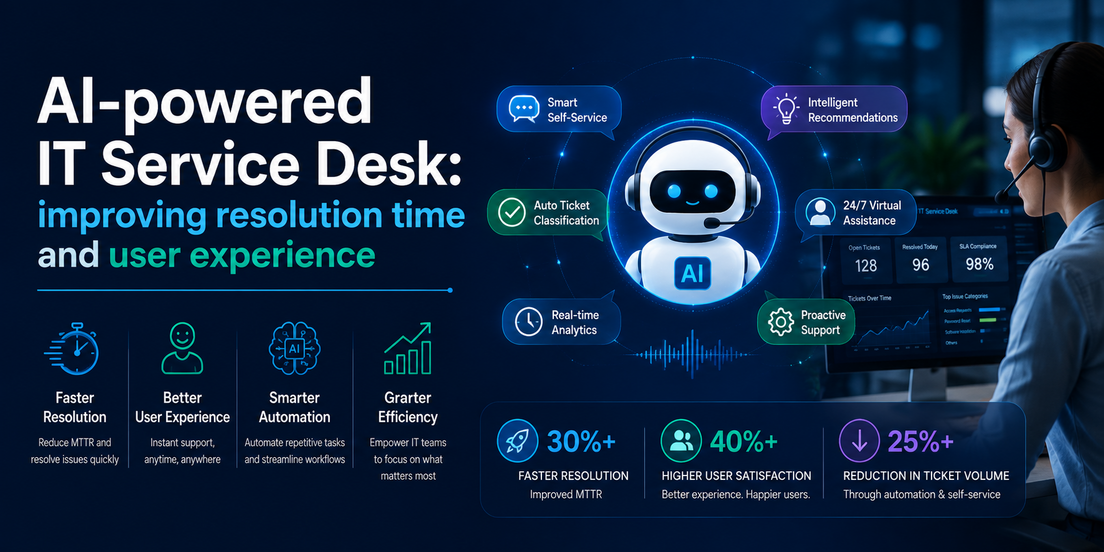
As organizations progress along their digital transformation journey, IT service desks are under growing pressure. Employees want instant support, quicker resolution of issues and seamless access to business applications, no matter where they are or what device they’re on. Meanwhile, IT teams are dealing with environments that are becoming increasingly complicated, with limited resources and a growing volume of tickets.
Often, such expectations conflict with traditional service desk models, which depend heavily on manual processes and reactive support. Slow responses, repeated service requests and inefficient ticket routing can affect employee productivity and overall business operations.
Artificial intelligence (AI) is changing the way IT service desks work. AI-powered IT service desks enable organizations to deliver faster support and significantly enhance the user experience through automation of routine tasks, intelligent incident routing, prediction of potential issues, and self-service capabilities.
At PIT Solutions, we help organizations modernise their IT operations with intelligent automation, AI-driven service management and scalable Managed IT Services. Whatever your goal-to improve response times, reduce operational costs, or increase employee productivity-our experts design solutions customised to your business needs and provide secure, dependable IT support.
What Is an AI-Powered IT Service Desk?
An AI IT service desk combines traditional IT Service Management (ITSM) processes with artificial intelligence technologies such as machine learning, natural language processing (NLP), predictive analytics and intelligent automation. This approach is also commonly referred to as AI-powered ITSM, where AI capabilities are integrated into service management workflows.
AI doesn’t just record and tag tickets, it analyses user requests, interprets intent, suggests solutions, automates repetitive workflows, and learns from past interactions. This allows IT teams to offer proactive support rather than being reactive only after the fact.
It results in a smarter, more efficient service desk, enhancing operational efficiency and employee satisfaction.
Why Traditional IT Service Desks Face Growing Challenges
Modern organizations rely on hundreds of business applications, cloud services, remote employees and connected devices. As IT environments become more distributed, service desk teams are dealing with an increasing number of support requests every day.
Service desk analysts spend much of their time on repetitive tasks such as password resets, software installs, access requests and standard troubleshooting, resulting in delayed ticket resolution for many organizations. Manual ticket categorization and routing can also increase response times, while limited visibility into recurring incidents makes proactive problem management difficult.
IT teams often struggle to scale support and maintain high service quality without automation and intelligent decision-making.
AI-Powered vs. Traditional IT Service Desks
Traditional IT service desks are heavily dependent on manual ticket logging, categorization, assignment, troubleshooting and resolution. As ticket volume grows, these processes can cause delays and put a strain on support teams.
AI-powered service desks embed intelligent automation into these workflows. AI is able to understand user requests, tag and rank tickets, recommend solutions, automate routine requests, and escalate complex incidents to the right specialists. This means that IT teams can spend less time on repetitive tasks and more time on challenges that need human expertise.
The biggest difference is the move from reactive support to proactive and intelligent service management. Traditional service desks tend to respond after an employee reports an issue, but AI-powered service desks can identify recurring patterns, provide self-service help and use analytical tools to assist with predicting potential problems.
For businesses, this means faster support, more efficient use of IT resources and a more consistent employee experience. AI doesn’t replace the service desk team; it extends human expertise through automation of routine work and information to better tackle complex issues.
How AI Improves IT Service Desk Resolution Time
One of the biggest advantages of IT service desk automation is that they can decrease the time to resolve incidents without decreasing the quality of service.
Intelligent Ticket Classification and Routing
The AI automatically analyses incoming service requests, determines the category of the request, assigns a priority level and routes the request to the appropriate support team. This means no more manual ticket assignment and incidents get to the right specialists much faster. This intelligent ticket routing helps ensure that incidents reach the appropriate specialists without unnecessary delays.
Automated Resolution of Common IT Requests
Many service requests involve repetitive tasks executed according to defined processes. IT support automation can handle routine requests such as password resets, account unlocks, software provisioning and access approvals with minimal technician intervention. This can support automated ticket resolution for predefined, low-complexity requests while allowing technicians to focus on more complex issues.
Predictive Issue Detection
The AI constantly monitors operational data for patterns that may suggest potential system failures or recurring incidents. By leveraging AI and Data Science Services, organizations can apply advanced analytics and machine learning to identify these patterns, predict potential issues, and make more informed IT service management decisions. Instead of waiting for users to report problems, IT teams can proactively address potential issues before they impact business operations.
How AI Enhances the IT Service Desk User Experience
The effectiveness of an IT service desk is measured not only in technical performance, but also in the quality of the user experience.
AI-driven chatbots and virtual assistants can provide round-the-clock responses to frequently asked questions. Employees don’t have to wait in long queues for support for simple requests. Natural Language Processing means the user can communicate using conversational language, making support interactions more intuitive.
AI also provides personalised support based on prior requests, user role, devices and app usage. This translates to faster recommendations and more relevant solutions, leading to higher employee satisfaction and less frustration.
Benefits of AI-Powered IT Service Desks
AI-powered IT service desks provide a significant boost to operational efficiency across the entire organization.
Automating repetitive tasks reduces the amount of time that IT professionals spend on routine support tasks, freeing them up to focus on strategic initiatives such as infrastructure modernization, cybersecurity and digital transformation. AI-driven analytics also help organizations use resources better, reduce operating costs, improve consistency of service and provide more accurate reporting. Monitoring trends in ongoing service helps to detect recurring problems and allows for long-term improvements in IT service quality.
The business value of AI-powered IT Service Management is also supported by industry research. Gartner highlights that organizations are increasingly adopting AI and intelligent automation to transform service desks from reactive support functions into proactive service operations, enabling faster service delivery, improved productivity, and enhanced employee experiences.
Published case studies show that after implementing AI-enabled IT service management, repetitive user queries were reduced by up to 30% and the percentage of tickets resolved in each support cycle increased from 65% to 78.2%. Such improvements enable IT teams to deliver faster, more consistent support to end users, and to focus on higher-value initiatives.
Challenges of Implementing AI in IT Service Desks
While AI is of great benefit, it requires careful planning and expertise to make it successful.
Challenges that organizations typically face include integrating AI with existing ITSM platforms, maintaining quality data for machine learning, re-engineering service workflows, and handling organizational change. Employees need to be assured that AI will complement, not replace, human support.
Without proper implementation strategies, AI initiatives might not deliver the expected business value.
How PIT Solutions Helps Organizations Build Intelligent Service Desks
Implementing an AI-enabled IT service desk is far more than just deploying chatbot software. This means that AI capabilities must be aligned with existing IT Service Management (ITSM) processes, business objectives, security policies and user expectations.
At PIT Solutions, we help organizations transform traditional support models into intelligent, proactive service desks by combining AI, automation, and ITIL best practices.
Our experts will review your existing service desk processes and identify opportunities to automate, integrate AI capabilities with your enterprise platforms, and optimise your workflows to improve service delivery and operational efficiency.
Through our Managed IT Services and Managed IT and Cyber Security Services we provide 24×7 support, intelligent incident management, proactive monitoring, workflow automation and continuous service improvement. Our solution helps organizations decrease response times, increase first-contact resolution, enhance service desk efficiency and provide a more consistent support experience for employees.
The Future of AI in IT Service Management
Artificial intelligence is evolving rapidly, and AI in IT service management is expected to play an increasingly important role in how organizations deliver and manage IT services.
Future AI service desks will have even more predictive capabilities, automated root cause analysis, intelligent knowledge management and self-healing infrastructure. With cloud technologies and advanced analytics, AI will allow IT organizations to evolve from reactive support to autonomous service operations.
Businesses that embrace AI-powered IT support today will be in a stronger position to boost operational efficiency, enhance employee productivity and deliver exceptional digital experiences.
Frequently Asked Questions About AI-Powered IT Service Desks
1. Is an AI-powered IT service desk suitable for small and medium-sized businesses?
Yes. AI-driven service desks can benefit businesses of all sizes. Standard artificial intelligence can help small to mid-size organizations deliver better support without adding a lot of resources to their IT teams. Also scalable to business needs, the cloud-based ITSM platforms and AI tools are suitable for organizations with varying budgets and support needs.
2. Does an AI-powered service desk require employees to have technical knowledge?
No. AI-enabled service desks are intended to make IT support for employees easier, including those who do not have technical expertise. Users can describe what they want in natural language and the system interprets the request and guides the user through the appropriate process or solution.
3. Can AI-powered service desks work with existing ITSM platforms?
Yes. AI capabilities can generally be integrated with existing ITSM platforms, enterprise applications and other business systems through APIs, connectors and automation workflows. This empowers organizations to build on their existing service desk infrastructure, rather than replace the entire platform.
4. How secure is an AI-powered IT service desk?
Security is dependent upon the design, configuration, and governance of the AI service desk. Organizations should put in place appropriate controls on access, data protection measures, encryption, audit mechanisms and security policies. AI solutions need to be configured to ensure that only authorised users can access sensitive business and employee information.
5. How can organizations measure the success of an AI-powered IT service desk?
Metrics like employee satisfaction, service desk adoption, self-service usage, ticket backlog, support costs and overall service quality can be used by organizations to measure success. Comparing these metrics before and after implementation can help organizations determine whether the AI-enabled service desk is delivering measurable business value.
Conclusion: Transform Your IT Support with AI
The modern workplace demands faster support, higher service quality, and seamless digital experiences. Traditional service desk models are no longer capable to meet these increasing expectations.
AI-powered IT service desks allow organizations to speed up resolution times, automate routine support tasks, improve user satisfaction, and optimise IT operations through intelligent automation. As businesses continue their digital transformation, AI-driven service management is no longer an operational enhancement but a strategic advantage.
At PIT Solutions, we bring together AI, automation, cloud experience and ITIL-based service management to help organizations build intelligent, scalable and future-ready IT support operations. Our Managed IT and Cyber Security Services help businesses reduce downtime, improve employee experiences and achieve operational excellence.
Ready to feed an innovative method to do IT support? Contact our Managed IT Services to schedule a consultation to find out how our AI-powered IT Service Desk solutions can speed up issue resolution, improve user experience, and increase business productivity.