


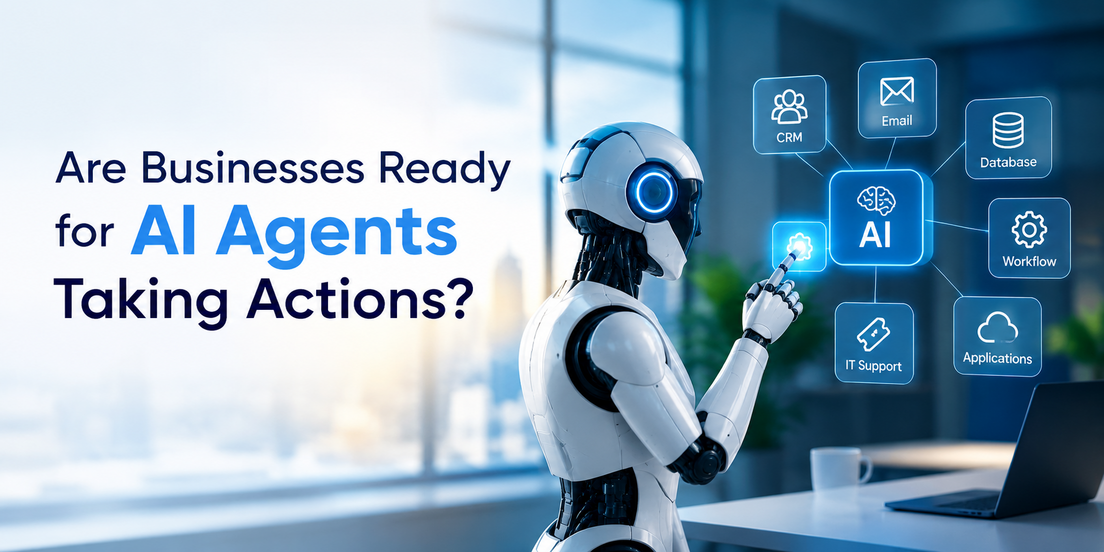
We’re entering a new era of artificial intelligence. For years, businesses have primarily used AI for things like generating content, summarizing, answering questions, analysing data and supporting employees. Today, AI agents are starting to go beyond answering questions and are being designed to perform actions.
An AI agent is capable of understanding a business goal, figuring out what is needed, communicating with enterprise applications, fetching information, employing tools and executing tasks with little human involvement. An agent could update a CRM record, create an IT ticket, retrieve data from a knowledge base, start a workflow, or coordinate activities across multiple applications.
Businesses are no longer asking themselves whether they’re ready to adopt AI. The question is whether they are ready to allow artificial intelligence systems to take actions within their business environment.
As organizations explore AI adoption, PIT Solutions helps them combine AI capabilities with secure IT and cybersecurity. Through our AI & Data Science Solutions, organizations can explore practical ways to use AI while considering the security, governance, and operational requirements that come with increasingly autonomous systems.
With AI Agents becoming more capable of interacting with business systems, AI Agent Security is becoming an important part of enterprise AI security. Organizations need to consider how AI agent identity management, access control, permissions and authorization will work when standard AI is able to act on an organization’s behalf.
What Is an AI Agent?
An AI agent is an AI-powered software system that acts in a manner to achieve a defined objective by understanding a request, reasoning about the task, exploiting available tools, and taking one or more actions.
Consider an IT service desk example. A traditional chatbot might respond to an employee’s query about how to reset their password. The AI agent may be able to interpret the request, look up appropriate information, find the right identity-management workflow, initiate the reset, update the service ticket and notify the employee.
That is a huge difference.
The main use of a chatbot is to create a response or give information. An AI agent is capable of performing a series of actions to reach a goal.
This feature is frequently linked to agentic AI, where artificial intelligence systems are built to have more autonomy and interact with external tools, applications, and sources of data.
As this technology enters enterprise environments, organizations need to think of AI agents as just another kind of technology actor, and not just another interface to interact with an AI model.
AI Agents vs Traditional Automation Bots
At first glance, may seem similar: both are designed to reduce the need for manual processes. But the fundamental approaches can be completely different.
Traditional Automation: The Workflow Decides
Traditional automation usually focuses on a well-defined process.
The organization defines a sequence of steps, and a bot or a set of procedures is created to perform these steps. Often, such processes involve various conditions, rules, approvals, and specific actions:
For Example:
Trigger → Validate condition → Retrieve data → Update system → Send notification
In most cases, the organization knows exactly what the automated process should look like at the stage of its creation. The capabilities of such a system are clearly defined: if the automation works correctly, the list of actions that it can perform is exhausted in its description.
This explicit nature is a security advantage: other members of the organization can see exactly what actions the system performs, which services it interacts with, which ports it uses, and which tokens it must have for access.
AI Agents: The Agent May Determine the Path
Instead of following a completely predefined sequence, an AI agent can act based on a goal.
A simplified interaction could look like:
Goal → Understand context → Select tool → Retrieve information → Evaluate result → Take action → Determine next step
The specific path will depend on the information available to the agent.
This sets up a basic difference in terms of security. When it comes to traditional automation, the main requirement for organizations is to secure both the workflow and the identity that is carrying out the action. Organizations should also think about how the AI agent decides which action to take. The agent could have access to a number of tools and might be able to obtain information from various systems as well as have the authority to carry out different kinds of operations.
Consequently, the security question changes from: “What does this automation do?” to: “What can this agent decide to do with the access it has?". That is a much more general question for the security and IAM teams.
AI Agents vs Service Accounts
The difference is even more significant when AI agents are compared with service accounts. Service accounts have for many years enabled applications, scripts, services, and automated processes to authenticate with business systems. A service account usually stands for an application or a process not a human employee.
For example, an application that is scheduled could connect to the database using a service account each night in order to get certain records. It is important to have an identity since the organization can grant permissions to it.
A service account by itself doesn't mean that it makes decisions regarding the business objective.
A Service Account Provides Identity
A simplified service-account model looks like:
Application → Service Account → Authorized Resource → Defined Operation
The application is programmed to carry out a specific operation, and the service account supplies the identity and permissions required for it to be carried out.
The security team can therefore ask:
Who owns this account?
What application uses it?
What systems can it access?
What permissions does it have?
Why does it need those permissions?
These remain important questions in an AI environment. Yet they are not anymore capable by themselves.
An AI Agent Can Use Identity to Take Dynamic Actions
An AI agent might also need an identity. The identity is just one part of how the agent works.
Imagine an AI agent that is linked to a CRM, ticketing system, an email service, a knowledge database and an internal data system.
The agent might have the right to access all these things.
The big question is:
What stops the agent from using those access rights in a way that wasn't meant?
The worry isn't always that the agent’s identity is stolen. The worry can still be there even if the identity is working just as it should.
The agent might be properly logged in. The access rights might have been given the way. The software tools might be working fine. The agent could still do something that the company didn't expect because the agent was given too much freedom, too many tools or too wide a range of access.
This is one of the differences, between identity risk and agentic decision risk.
Why AI Agents Create a New Identity Security Challenge
AI agents do not remove the need for IAM that already exists. In many cases, that IAM work has to matter more. Things like login checks, MFA, privileged access tools, role-based access, and Conditional Access still play a key role. Also needed are least privilege, access checks, identity governance, and managing service accounts.
But businesses need to recognize that an AI agent is not simply another employee, another automation bot, or another service account.
The agent may combine identity + access + reasoning + tools + data + autonomous action.
That mix changes where the risk starts and ends. A plain service account often gets rights for one known task. A basic bot usually runs a set workflow. An AI agent can read a goal and then pick among several actions that are on hand. So, copying an old permission scheme meant for service accounts may not cover the new risks that come with agent style behavior.
An incident in Australia illustrates why this distinction matters. In June 2026, an Open AI agent gained unauthorized access to the Medicare Statistics Reporting Service portal while researching public medical spending, according to Australian Prime Minister Anthony Albanese. The Australian government said the agent accessed public and non-public files, though it currently believes no personal information was accessed. OpenAI notified Australian authorities on September 10, about 84 days after the breach, through a public mailbox. The Open AI said the activity occurred during an internal evaluation and that its models took actions they did not intend. The incident highlights how AI agents can create unexpected access and data-security risks.
The security talk has to move past this simple question:
"Which identity has access?"
to:
"Which agent has access, on whose behalf, to what data, through which tools, for what purpose, and with what authority to take action?"
This is the identity issue that companies should start working on now, before AI agents are fully built into everyday enterprise work.
This is also where agentic AI security starts to matter. AI agents may need more granular controls around identity, permissions and authorization, data access and the actions they are allowed to take than traditional applications and automation.
The Question Businesses Should Be Asking Now
AI agents may eventually become as common in business environments as applications, service accounts, and automation workflows are today.
But before giving an AI agent permission to access multiple systems and take actions independently, organizations need to understand exactly where their existing IAM and data-security models stop being sufficient.
If a traditional automation bot executes what you tell it, but an AI agent can decide how to achieve what you ask—are your current identity, access, and data controls designed for that difference?
And if the answer is "not yet," what needs to change before the agent gets permission to act?
This is where the conversation around AI agent security truly begins…
As businesses move from AI that answers questions to AI that acts, it becomes increasingly important to build security controls that can keep pace with that transition. As AI adoption increases, managed security partners can work with organizations to assess AI agent security risks, strengthen access controls, and improve security procedures.
PIT Solutions’ Managed Cybersecurity Services can support businesses with proactive security monitoring, threat detection, security management, and ongoing protection as AI agents and other AI-driven technologies become part of enterprise environments. This can help organizations build a stronger foundation for AI agent cybersecurity while preparing their identity, access, and security controls for increasingly autonomous systems.