


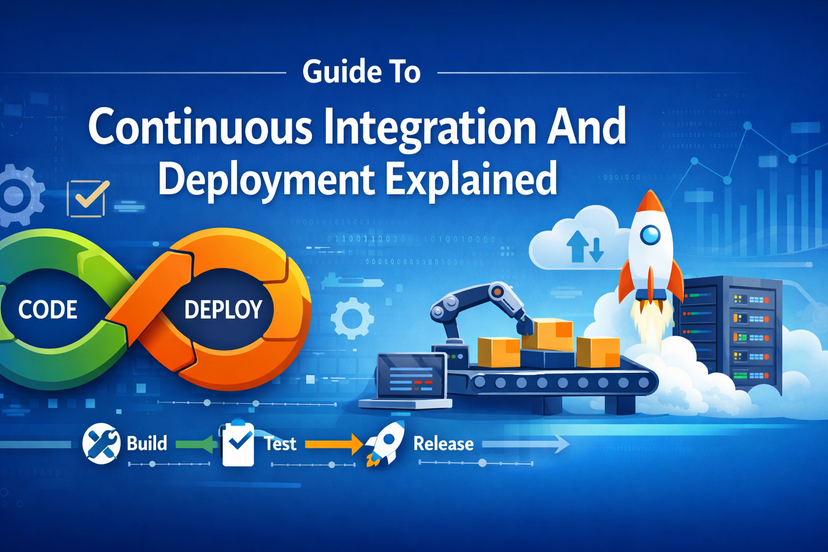
Modern software delivery demands speed without sacrificing reliability. CI/CD has emerged as the backbone of this shift, enabling teams to release software faster through disciplined automation while maintaining stability at scale. More than a set of tools or pipelines, CI/CD represents both a technical practice and a cultural shift, one that embeds continuous testing, automated validation and shared ownership into the software lifecycle. By standardizing how code is built, tested and deployed, CI/CD transforms delivery from a risky event into a predictable, repeatable process aligned with business velocity and long-term system resilience, making it a practical Guide to Continuous Integration and Deployment for modern engineering teams.
What Is CI/CD? A Clear and Practical Explanation
CI/CD is a modern software delivery approach that uses automated pipelines to streamline how code is built, tested and released. It replaces manual, error prone processes with software lifecycle automation, enabling teams to deliver changes faster and more reliably. Based on this CI/CD complete guide, understanding CI vs CD vs continuous deployment clarifies how each practice contributes to speed, stability and controlled releases.
Continuous Integration (CI) Explained
Continuous Integration focuses on frequent code commits to a shared repository. Each commit triggers automated builds and tests, allowing teams to validate changes immediately and catch defects early in the development cycle.
Continuous Delivery (CD) Explained
Continuous Delivery ensures that every successful build is always in a deployable state. While deployments to production require manual approval, the release process remains consistent, low risk and ready at any time.
Continuous Deployment Explained
Continuous Deployment extends delivery by automating production releases. Once code passes all checks, it is deployed automatically, enabling high deployment frequency and rapid feedback without manual intervention.
The Evolution of Software Development and the Rise of CI/CD
Software delivery has progressed from rigid Waterfall models to agile development, enabling iterative software delivery and faster feedback. As systems grew more complex, DevOps culture emerged to improve collaboration and automation across teams. CI/CD is the next step in this evolution. In this CI/CD overview, cloud native development and microservices demand frequent, independent releases and CI/CD provides the automation needed to deliver changes quickly, reliably and at scale.
Why CI/CD Is Critical for Modern Software Teams
CI/CD has become essential for teams building and operating modern software systems. By automating the delivery pipeline, teams can increase deployment frequency without compromising quality, while maintaining the reliability required to scale.
Speed, Stability and Scalability
CI/CD enables faster releases through consistent automation, while built in testing and validation protect stability as systems grow in size and complexity.
Business Agility and Faster Time-to-Market
Shorter release cycles improve release velocity, allowing teams to respond quickly to customer needs, market changes and competitive pressure.
Reduced Deployment Risk
Smaller, incremental deployments reduce failure impact and improve mean time to recovery (MTTR) when issues occur.
Improved Developer Experience
Automated workflows reduce manual effort and context switching, allowing developers to focus on building features rather than managing releases.
Key Benefits of CI/CD Pipelines
CI/CD pipelines standardize and automate how software moves from code to production. By combining automated testing with disciplined pipeline orchestration, teams deliver faster, safer releases while improving collaboration and reliability across the delivery lifecycle.
Faster Release Cycles
Automation removes manual bottlenecks, enabling frequent, predictable releases. This allows teams to deliver incremental value continuously without disrupting production stability.
Improved Code Quality Through Automation
Continuous testing catches defects early and enforces consistent quality standards. Automated validation reduces human error and prevents regressions from reaching production.
Increased Developer Productivity
Developers spend less time on manual builds and deployments and more time shipping features. This focus shift accelerates innovation and improves overall engineering throughput.
Stronger Collaboration Between Dev, QA and Ops
A shared pipeline aligns teams around a single and transparent delivery process. Clear ownership and visibility reduce handoff friction and communication gaps.
Faster Rollbacks and Incident Recovery
Automated deployments and versioning make reversions quick and low risk. This significantly shortens recovery time and limits business impact during incidents.
CI/CD Pipeline Architecture and Workflow Explained
A CI/CD pipeline is a structured flow that automates each stage of software delivery, from code commit to production feedback. This architecture ensures consistency, traceability and rapid feedback.
Code Commit & Version Control
Source code changes are tracked and managed centrally using tools like Git. This ensures version traceability, supports collaboration across teams and enables quick rollback to stable states when needed.
Automated Build Process
Each commit triggers a build to validate code consistency and dependencies. Automated builds ensure early detection of integration issues and maintain a reliable baseline for downstream testing and deployment stages.
Automated Testing Layers
Testing spans multiple levels:
-
Unit tests validate individual components
-
Integration tests verify system interactions
-
Security tests identify vulnerabilities
-
Performance tests ensure scalability
Artifact Management
Build outputs are stored in secure artifact repositories for traceability and reuse. This ensures consistent deployments across environments and simplifies rollback and audit processes.
Deployment to Staging
Pre-production environments validate release readiness. Staging allows teams to test functionality, performance and integrations in conditions close to production.
Production Deployment
Releases are deployed using controlled or automated strategies. This approach minimizes downtime and ensures predictable, repeatable production releases.
Monitoring, Logging and Feedback Loops
CI servers and observability tools provide real time feedback to continuously improve the pipeline. Continuous monitoring helps teams detect issues early and refine pipeline performance over time.
CI/CD vs Traditional Software Release Models
Traditional software release models depend heavily on manual deployments, long approval chains and infrequent release cycles. These approaches often introduce release bottlenecks, slow feedback and higher risk when changes finally reach production. CI/CD replaces this model with continuous automation and incremental delivery. Release frequency increases through smaller, frequent updates, while risk is reduced because each change is easier to test and roll back. Faster feedback cycles allow teams to identify issues early and a high level of automation ensures consistency, reliability and predictable software delivery at scale.
Popular CI/CD Tools and Platforms
Modern CI/CD automation tools support scalable pipeline orchestration across cloud and on-prem environments, integrating testing, security and deployment into a single workflow. According to the CI/CD complete guide, this unified approach reduces tool sprawl, improves visibility across the pipeline and enables teams to manage complex delivery processes with greater control and efficiency.
CI/CD Best Practices for Successful Adoption
Automate Everything Possible
Automating builds, tests and deployments reduces human error and improves delivery speed. It also ensures consistency across environments and minimizes dependency on manual intervention.
Build High-Quality Test Coverage
Comprehensive automated testing ensures reliability and prevents regressions as release velocity increases. Strong test coverage builds confidence to deploy changes frequently and safely.
Use Feature Flags for Safer Releases
Feature flags allow controlled rollouts and quick reversals without redeployments. This enables teams to test features in production with limited exposure and reduced risk.
Implement Infrastructure as Code (IaC)
Tools like Terraform and AWS CloudFormation standardize infrastructure provisioning and improve consistency. IaC also enables version control, repeatability and faster environment recovery.
Secure the CI/CD Pipeline (DevSecOps)
Embedding security checks early through DevSecOps reduces vulnerabilities and compliance risks. Shifting security left ensures issues are detected before they reach production.
Keep Pipelines Fast and Reliable
Optimized pipelines maintain developer trust and prevent delays in feedback loops. Fast pipelines encourage adoption and ensure CI/CD remains a productivity enabler rather than a bottleneck.
Common CI/CD Challenges and How to Overcome Them
Legacy Systems and Monolithic Architectures
Older systems resist automation and require gradual refactoring or hybrid pipelines. Breaking monoliths into smaller components enables incremental CI/CD adoption without disrupting core functionality.
Cultural Resistance and Skill Gaps
Teams may resist change without proper training and leadership support. Strong change management and upskilling programs help align teams with CI/CD practices.
Pipeline Performance Issues
Slow pipelines reduce adoption and require continuous pipeline optimization. Optimizing test execution, parallel builds and caching significantly improves pipeline speed.
Toolchain Complexity
Too many tools increase maintenance overhead and integration friction. Standardizing and rationalizing tools simplifies management and improves pipeline stability.
Security and Compliance Concerns
Security must be automated and standardized to scale safely. Integrating security checks early in the pipeline ensures compliance without slowing delivery.
Based on this guide to continuous integration and deployment, addressing these CI/CD adoption challenges early ensures long-term success and sustainable delivery velocity.
CI/CD for Cloud-Native and Microservices Architectures
CI/CD is foundational for cloud native systems built on containers and microservices. Containerized deployments using Docker and Kubernetes native pipelines with Kubernetes enable independent, service level deployments. This approach supports rapid scaling, isolated failures and continuous delivery across distributed systems.
CI/CD Metrics That Matter
Measuring the right CI/CD performance metrics drives continuous improvement. Key indicators include deployment frequency, lead time for changes, change failure rate and mean time to recovery, collectively known as DORA metrics. These metrics provide objective insight into delivery efficiency, reliability and operational maturity.
CI/CD Use Cases Across Industries
SaaS & Product Companies
CI/CD enables rapid feature delivery, experimentation and continuous user feedback.
FinTech & Banking
Automation supports secure, auditable releases with strict compliance controls.
Healthcare & Compliance-Driven Industries
CI/CD balances automation with governance to meet regulatory requirements.
E-commerce & High-Traffic Platforms
High deployment frequency and fast rollbacks support peak traffic and seasonal demand.
The Future of CI/CD
CI/CD continues to evolve with AI driven pipelines, predictive testing, GitOps and platform engineering. Advances in AI in DevOps will further optimize pipelines by predicting failures, reducing test execution time and improving release reliability at scale, clearly demonstrating how CI/CD explained today extends far beyond basic automation into self-optimizing delivery systems.
Final Thoughts: Building Faster, Safer Software with CI/CD
CI/CD is no longer just a DevOps tool, it is a business enabler that drives speed, resilience and scalability. An automation first, continuously improving mindset is essential for organizations building cloud native, AI ready systems. Partnering with experienced DevOps specialists like PIT Solutions, a trusted IT solutions company delivering advanced CI CD Services, helps businesses design secure, high-performance pipelines aligned with long term growth and digital transformation goals. Together, these practices form a practical Guide to Continuous Integration and Deployment for organizations seeking faster, safer and more reliable software delivery.