


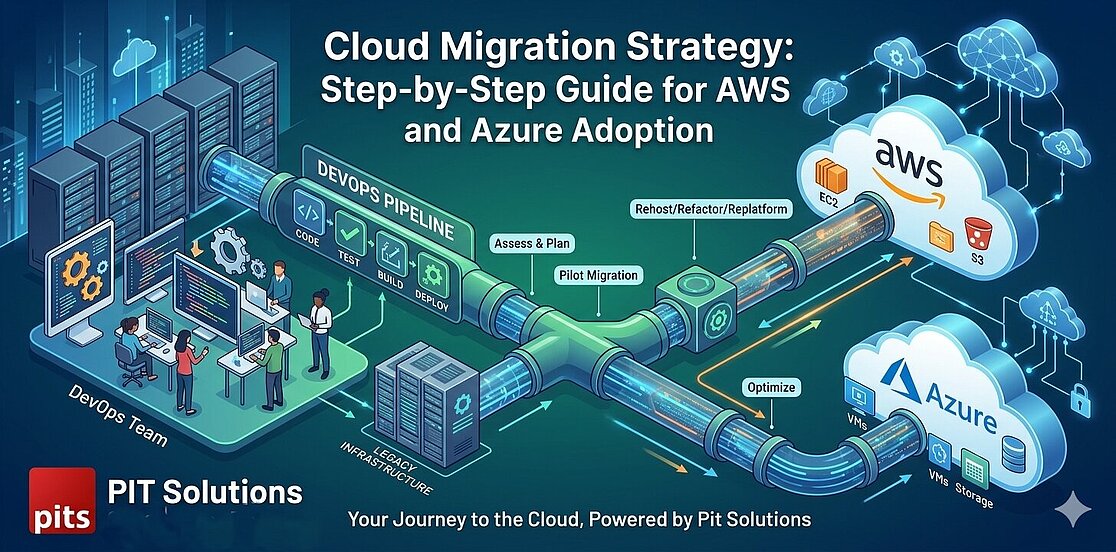
Cloud Migration Strategy defines a structured approach for moving applications, data, and infrastructure into cloud environments with controlled risk and clear planning, supporting AWS and Azure adoption through guided pathways for workload assessment, selection, and execution. Enterprise cloud migration aligns technical decisions with business goals to improve scalability, performance, and security. Structured migration planning enables smooth transitions, efficient resource utilization, and consistent outcomes across AWS and Azure ecosystems, helping organizations modernize infrastructure and adopt cloud platforms with confidence and clarity.
What Is a Cloud Migration Strategy and Why It Matters
Cloud migration strategy is a structured plan for moving applications, data, and infrastructure across cloud environments in alignment with business goals. A strong cloud adoption strategy supports business-driven cloud migration by improving cost optimization, performance scalability, and security modernization. It guides organizations through cloud infrastructure modernization while strengthening operational efficiency. As part of a broader digital transformation strategy, structured migration planning helps enterprises reduce risks, improve agility, and achieve sustainable cloud success.
Understanding AWS and Azure Cloud Platform
AWS vs Azure cloud services comparison helps enterprises evaluate leading cloud platforms based on infrastructure, scalability, and business requirements. Understanding both ecosystems supports informed cloud adoption decisions, enabling organizations to select suitable solutions for performance, integration, and long-term operational success.
Overview of AWS Cloud Services
- Compute services for scalable workloads.
- Storage solutions for secure data handling
- Networking tools for cloud connectivity
- Supports enterprise application deployment
Overview of Azure Cloud Services
- Azure Virtual Machines for compute workloads
- Azure Storage for data management
- Azure Networking for secure connectivity
- Integration with Microsoft ecosystem services
AWS vs Azure: Selecting the Right Cloud Provider
- Compare performance and scalability options.
- Evaluate cost and service flexibility.
- Amazon EC2 for AWS compute workloads.
- Azure Virtual Machines and Azure Storage for Azure environments
Cloud Migration Strategy Models Explained
Cloud migration models provide structured approaches for moving workloads to cloud environments based on business goals, technical complexity, and modernization priorities. These models help organizations choose the most effective migration path while improving efficiency, reducing risks, and supporting successful long-term cloud transformation.
Rehost (Lift and Shift) Strategy
- Move applications without code changes.
- Fast migration with minimal disruption
- Suitable for legacy systems requiring quick cloud entry
- Maintains existing architecture in the cloud
Replatform Strategy
- Apply minor optimizations during migration.
- Use managed cloud services for better efficiency.
- Improve performance without a full redesign.
- Balance speed and modernization
Refactor Strategy
- Redesign applications for cloud-native architecture
- Enhance scalability and flexibility.
- Requires code-level modifications
- Supports long-term cloud optimization
Repurchase Strategy
- Replace existing systems with SaaS solutions.
- Reduce maintenance and operational overhead.
- Enable faster deployment using ready platforms.
- Shift ownership to service providers.
Retire Strategy
- Decommission unused or outdated applications
- Reduce infrastructure cost and complexity.
- Improve resource utilization
- Focus on active business systems.
Retain Strategy
- Keep selected workloads on-premises
- Used for compliance or dependency requirements
- Delay migration where needed
- Maintain stability for critical systems.
Cloud Readiness Assessment for AWS and Azure Migration
Cloud readiness assessment evaluates infrastructure, applications, data, and security to determine whether workloads are prepared for AWS and Azure migration. It helps organizations reduce risks, identify gaps, and ensure stable cloud adoption through structured evaluation using cloud discovery tools and workload dependency mapping, supported by platforms like Azure Migrate and AWS Migration Hub
Infrastructure Readiness
Infrastructure readiness evaluates server capacity, network configuration, virtualization, and scaling needs to determine whether systems are ready for the cloud. It identifies infrastructure gaps that could affect system performance. Tools such as Azure Migrate evaluate compatibility for smooth AWS and Azure migrations.
Data Readiness
Data readiness focuses on evaluating data structure, volume, and quality before migration. It ensures secure transfer planning while maintaining integrity across platforms. Workload dependency mapping helps identify data relationships that influence migration sequencing and execution.
Security Readiness
Security readiness evaluates access controls, encryption methods, compliance policies, and identity management. It safeguards data during the migration process. It also checks compliance with governance policies, ensuring secure cloud environments in AWS and Azure.
Step-by-Step Cloud Migration Process for AWS and Azure
A step-by-step cloud migration process guides workload movement across AWS and Azure through planned stages, including assessment, planning, execution, validation, and optimization to ensure controlled migration, reduced risks, and stable enterprise cloud operations.
Step 1 – Define Business Goals and Migration Scope
- Define clear business objectives for migration outcomes.
- Identify applications, systems, and workloads for migration.
- Align technical execution with business priorities.
- Set success metrics for migration progress.
Step 2 – Inventory and Dependency Mapping
- Build a complete inventory and dependency mapping of systems.
- Identify applications, servers, and data assets.
- Analyze relationships between interconnected workloads.
- Reduce migration risks by understanding system dependencies.
Step 3 – Select Cloud Migration Tools
- Select suitable tools for AWS and Azure environments.
- Use Azure Migrate for assessment and discovery.
- Apply AWS Application Migration Service for workload movement.
- Improve automation, accuracy, and execution efficiency.
Step 4 – Execute Data Migration
- Transfer data securely from on-premises to cloud platforms.
- Ensure minimal downtime during migration execution.
- Maintain data integrity and consistency throughout the process.
- Support stable workload transition across environments.
Step 5 – Validate Applications and Performance
- Conduct migration testing for application functionality.
- Evaluate performance and system stability in a cloud environment.
- Verify compatibility under real workload conditions.
- Ensure readiness for production deployment.
Step 6 – Optimize and Monitor Post-Migration
- Apply cloud optimization for better performance and cost control.
- Monitor system behavior continuously after migration.
- Identify performance gaps and improvement areas.
- Enhance long-term stability of cloud operations.
AWS to Azure Migration Strategy Explained
AWS to Azure migration involves a structured approach for moving workloads from AWS environments to Azure platforms, focusing on planning, architecture alignment, and secure data transition to ensure smooth cloud platform migration with strong cloud interoperability between both ecosystems.
Reasons to Migrate from AWS to Azure
Organizations choose Azure for seamless integration with Microsoft platforms and enterprise applications. Migrating to Azure is also driven by cost and licensing flexibility. Hybrid cloud integration also allows greater scalability and agility.
Migration Architecture Design
Migration architecture design defines how workloads will function after transitioning from AWS to Azure. It ensures system compatibility, scalability, and performance alignment. Proper design reduces operational risks and supports stable workload execution across cloud environments.
Data Migration and Synchronization
Data migration and synchronization ensure the secure transfer of workloads between platforms. Azure Database Migration Service enables smooth database movement with minimal disruption. Azure Site Recovery supports replication and failover to maintain continuity and reduce downtime during migration
Key Tools for AWS and Azure Cloud Migration
Cloud migration tools help enterprises plan, execute, and manage workload transfers between AWS and Azure by enabling automation, visibility, and control across complex migration environments. These tools support efficient migration workflows while improving accuracy, security, and operational consistency across cloud platforms.
AWS Migration Tools
AWS Migration Hub provides centralized tracking of application migrations across AWS services. AWS Database Migration Service offers secure and continuous database migration with low downtime, allowing for seamless workload migration and improved visibility of migrations across environments.
Azure Migration Tools
Azure Migrate supports discovery, assessment, and planning of cloud workloads before migration. Azure Site Recovery ensures business continuity through replication and disaster recovery, helping maintain system availability and reducing downtime during migration execution.
Third-Party Migration Tools
Terraform automates infrastructure provisioning across cloud environments for consistency and speed. Kubernetes manages containerized applications for scalable deployment. VMware supports virtual machine migration, enabling flexible workload movement and improving migration orchestration across hybrid cloud setups.
Cloud Migration Security and Compliance Best Practices
Cloud migration security ensures the protection of data, applications, and infrastructure during cloud transition through strong identity control, encryption, and compliance planning. Identity and Access Management using Azure Active Directory and AWS Identity and Access Management secures authentication and access control across systems. Data encryption strategies protect sensitive information in transit and at rest, while regulatory compliance planning ensures adherence to industry standards. These practices strengthen cloud governance and support alignment with established compliance frameworks in enterprise cloud
Common Cloud Migration Challenges and How to Overcome Them
Cloud migration challenges involve technical and operational issues that impact smooth workload transfer, including risks, compatibility gaps, and performance limitations, often leading to migration failure risks and workload migration challenges if not properly addressed during planning.
Downtime Risks
- Service interruptions during migration windows
- Business operations are affected by system unavailability.
- Careful planning reduces downtime impact.
- Phased migration ensures a smoother transition.
Data Loss Concerns
- Risk of incomplete or corrupted data transfer
- Backup strategies prevent permanent data loss.
- Validation checks ensure data integrity.
- Secure transfer methods reduce exposure risks.
Performance Bottlenecks
- Reduced application speed during migration phases
- Network and resource limitations impact performance
- Scaling strategies improve system efficiency.
- Optimization reduces latency and improves stability.
Cloud Migration Use Cases Across Industries
Cloud migration supports industry transformation by improving security, scalability, and operational efficiency across business sectors. Healthcare cloud migration enhances patient data security and compliance. Retail cloud migration improves inventory management, customer experience, and demand forecasting. Banking cloud migration strengthens transaction security, fraud prevention, and regulatory compliance. Manufacturing cloud migration optimizes supply chain visibility, production monitoring, and operational efficiency, enabling smarter decisions and scalable growth.
Future Trends in Cloud Migration Strategy
Cloud migration trends are reshaping enterprise transformation through AI-driven cloud migration powered by intelligent automation, improving planning accuracy and operational efficiency. Multi-cloud and hybrid cloud adoption provide flexibility, cost control, and stronger compliance across platforms. Cloud-native application development accelerates deployment, scalability, and innovation while supporting cloud modernization, helping organizations build resilient, agile, and future-ready digital infrastructures.
FAQ Section
What is the best cloud migration strategy for enterprises?
The best cloud migration strategy depends on business goals, workload complexity, and existing IT infrastructure. Most enterprises use a mix of rehosting, replatforming, and refactoring to balance speed, cost, and modernization.
How long does a cloud migration take?
Cloud migration timelines vary based on application size, dependencies, and readiness. Simple workloads may take weeks, while complex enterprise systems can take several months to complete.
What tools are used for AWS and Azure migration?
Cloud migration timelines vary based on application size, dependencies, and readiness. Simple workloads may take weeks, while complex enterprise systems can take several months to complete.
Is the AWS to Azure migration complex?
AWS to Azure migration can be complex due to architecture differences and dependency mapping. However, proper planning, tool selection, and phased execution reduce risks and simplify the process.
Conclusion
A scalable cloud migration strategy enables enterprises to achieve secure, efficient, and structured workload transitions across AWS and Azure while supporting long-term optimization and continuous cloud improvement. Structured planning enhances performance, reduces risks, and improves operational efficiency over time. Continuous monitoring and optimization help organizations adapt to evolving business needs and maintain stability and growth. Pit Solutions is a trusted IT Partner delivering expert cloud migration support for secure execution, seamless AWS and Azure adoption, and long-term enterprise success.
Contact PIT Solutions for expert cloud migration support, secure AWS and Azure adoption, and scalable enterprise software solutions that drive performance, efficiency, and growth.