


Customers expect fast, accurate, and consistent help on every channel, but delivering that experience entirely in-house can become costly and difficult to scale. That is why customer support outsourcing services, often as part of a broader BPO strategy, have moved beyond being simply a cost-saving option. They can help organisations improve customer experience, increase operational flexibility, and enable internal teams to focus on core business priorities.
But with so many customer support outsourcing companies to choose from, how do you identify the right partner? This buyer’s checklist covers the eight areas that matter most, from omnichannel support and AI automation to scalability, security, and service quality, so you can compare providers with confidence and shortlist the right fit.
1. Define Your Customer Support Outsourcing Requirements
Before comparing providers, be clear about what you need.
- Which customer support channels need to be covered?
- Do you require 24/7 support?
- Is multilingual support important?
- What are your average and peak interaction volumes?
- Do volumes fluctuate seasonally?
- What response and resolution times do you expect?
- Which CRM, helpdesk, or ticketing platforms will the team use?
Clear requirements make it easier to compare providers and identify the operating model that best fits your business.
Buyer Tip: Look for a partner that takes time to understand your customer journeys, operational challenges, service expectations, and business objectives before recommending a solution.
2. Assess Industry and Process Experience
Customer support requirements can vary considerably between industries. An e-commerce customer checking an order needs a very different interaction from a banking customer querying a transaction or an insurance customer discussing a claim.
When comparing customer support outsourcing companies, look beyond general outsourcing experience and examine their ability to manage:
- Complex customer enquiries
- Escalations and exceptions
- Data-sensitive processes
- High-volume operations
- Industry-specific workflows
- Quality and compliance requirements
The objective is not simply to find an experienced outsourcing provider. It is to identify a partner with experience relevant to your customers, processes, and operating environment.
3. Check Omnichannel Customer Support Capabilities
Customers increasingly move between channels during the same service journey. They may begin with live chat, continue over email, and eventually call for assistance.
Effective customer support outsourcing services should therefore provide consistent support across multiple channels.
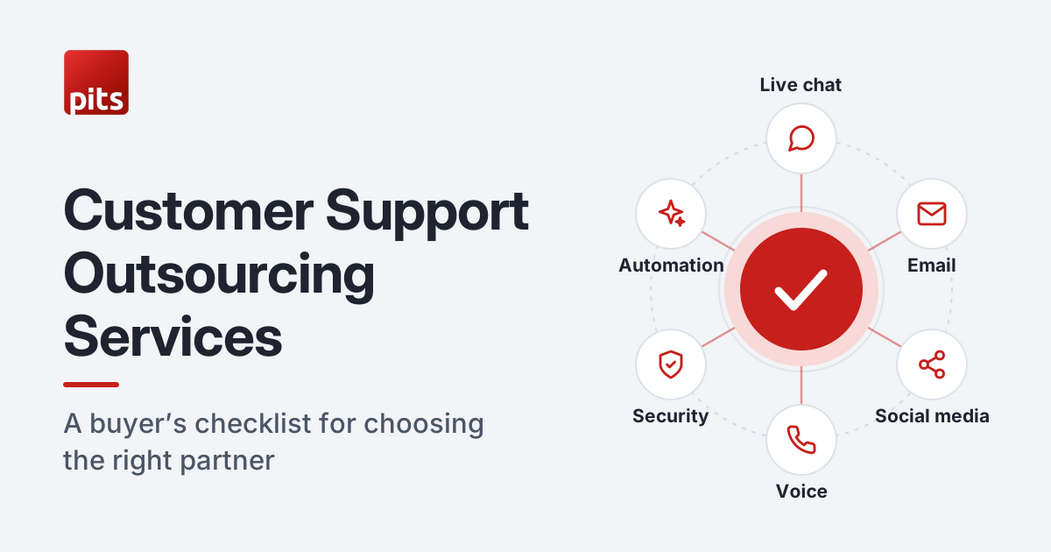
PIT Solutions offers omnichannel customer support across voice, live chat, email, and social media, with the aim of providing a consistent customer experience across touchpoints. Learn more about its Customer Support & Helpdesk Services.
When evaluating a partner, ask how customer information and interaction history move between channels.
Buyer Tip: Simply offering support through several channels does not necessarily mean the provider delivers an integrated omnichannel experience.
4. Evaluate AI and Automation in Customer Support
Technology is becoming an increasingly important part of modern customer support outsourcing solutions. Common AI and automation capabilities include:
- Ticket classification
- Intelligent routing
- Agent assistance
- Knowledge management
- Workflow automation
- Interaction analytics
- Quality monitoring
However, instead of simply asking, "Do you use AI?", ask a more important question:
"How does your technology improve customer experience or operational efficiency?"
The strongest operating models balance automation with human expertise. Routine and repetitive activities can be automated, while complaints, complex exceptions, and sensitive interactions benefit from human judgement and empathy.
PIT Solutions follows a human-and-AI approach that combines technology with the empathy and judgement of skilled customer support professionals.
5. Evaluate Quality Management and Support KPIs
When you outsource customer support, the provider's team represents your brand directly to your customers. Quality management should therefore be central to your evaluation.
- Agent training and coaching
- Quality monitoring
- Knowledge management
- Escalation procedures
- Root-cause analysis
- Continuous improvement
Key Customer Support KPIs to Track
Performance should also be measured against clearly defined KPIs.
| KPI | What It Measures |
| First Response Time | Speed of initial engagement |
| First Contact Resolution | Ability to resolve without repeat contact |
| Average Resolution Time | Efficiency of issue resolution |
| Customer Satisfaction | Customer perception of support |
| SLA Achievement | Operational consistency |
| Quality Score | Accuracy and process adherence |
Avoid focusing on speed alone. A customer interaction completed quickly but incorrectly can lead to repeat contacts, increased costs, and customer frustration.
6. Test Scalability and Flexibility for Peak Demand
Customer demand is rarely constant. Seasonal peaks, product launches, marketing campaigns, billing cycles, and business growth can all create sudden increases in support volumes.
One of the advantages of customer support outsourcing services is the ability to build greater operational flexibility. Organisations adopting broader Business Process Outsourcing Services can also extend this model across other process-driven functions as business needs evolve.
- How quickly can additional capacity be deployed?
- How are unexpected volume spikes handled?
- Can operating hours be expanded?
- Is multilingual support available?
- What business continuity measures are in place?
PIT Solutions highlights scalability, round-the-clock multilingual support, cost efficiency, and business continuity as benefits within its customer support service model.
Buyer Tip: Give shortlisted providers a realistic peak-volume scenario and ask them to explain how they would respond. This can reveal more about their operational maturity than simply asking whether they can scale.
7. Examine Data Security and Compliance
Customer support operations can involve access to personal information, customer records, internal systems, and other sensitive data. Security should therefore be evaluated from the beginning.
- Access controls
- Authentication
- Data protection
- Secure workflows
- Incident management
- Business continuity
- Disaster recovery
- Relevant regulatory requirements
This becomes especially important in industries such as banking and insurance, where customer support and backend processes can involve sensitive customer data and regulatory obligations.
PIT Solutions highlights secure workflows, accuracy, and regulatory compliance within its customer support and backend operations for banking and insurance organisations.
8. Look Beyond Price: Assess Overall Value
Cost is an important consideration, but it should not be the only deciding factor.
When evaluating customer support outsourcing companies, consider the overall value delivered through:
- Service quality
- Productivity
- Resolution rates
- Technology capabilities
- Scalability
- Customer satisfaction
- Operational resilience
The same principle should apply to broader BPO Services. The goal should not simply be to move work to a lower-cost environment. A stronger business case comes from improving efficiency, scalability, service quality, and business outcomes.
Effective customer support outsourcing services should ultimately be assessed on the value they create, not price alone.
Customer Support Outsourcing Services: Your Final Buyer’s Checklist
Business & Operational Fit
- Relevant industry and process experience
- Omnichannel support capabilities
- 24/7 or multilingual support where required
- Flexible and scalable capacity
Technology & Quality
- CRM and helpdesk integration
- AI and automation capabilities
- Clearly defined SLAs and KPIs
- Quality assurance framework
- Reporting and analytics
Security & Partnership
- Appropriate security controls
- Business continuity planning
- Transparent commercial model
- Structured governance
- Clear transition plan
- Continuous improvement approach
Choose a Customer Support Outsourcing Partner, Not Just a Provider
The best customer support outsourcing companies do more than provide people to answer calls or close tickets. They function as an extension of your organisation, bringing together people, processes, technology, analytics, and automation to improve both customer experience and operational performance.
Customer support can also be part of a wider Business Process Outsourcing strategy, enabling businesses to improve efficiency across multiple operational processes while allowing internal teams to focus on strategic priorities.
With more than 25 years of IT-enabled services experience, PIT Solutions provides customer support across voice, live chat, email, social media, and omnichannel environments. Its approach combines skilled support professionals with AI-enabled operations, scalable delivery, and secure workflows.
When evaluating your next customer support outsourcing partner, look beyond headcount and cost. Focus on whether the provider can deliver measurable improvements in customer experience, operational efficiency, scalability, and long-term business value.
Looking for Scalable Customer Support Outsourcing Services?
Learn more about how PIT Solutions can support your customer experience through Customer Support & Helpdesk Services, including voice, chat, email, social media, and omnichannel support.