


Software is now more than just an operational tool in today's digital-first economy; it is a key factor in customer satisfaction, business expansion, and competitive advantage. Applications are used by businesses in all sectors to provide services, oversee operations, and interact with clients in real time.
But the risks also increase with the speed at which software is delivered. Development-related security flaws can result in monetary losses, legal repercussions, business interruptions, and reputational harm.
Because of this, DevSecOps — a practice that integrates security testing and controls directly into the development and operations pipeline, making every developer and operations engineer equally responsible for security — is now a business-critical strategy that allows companies to innovate safely while controlling risk, rather than merely a technical practice. At PIT Solutions, we help enterprises embed security into every stage of the secure software development lifecycle — turning compliance and risk management into a competitive edge.
What is DevSecOps in Software Development?
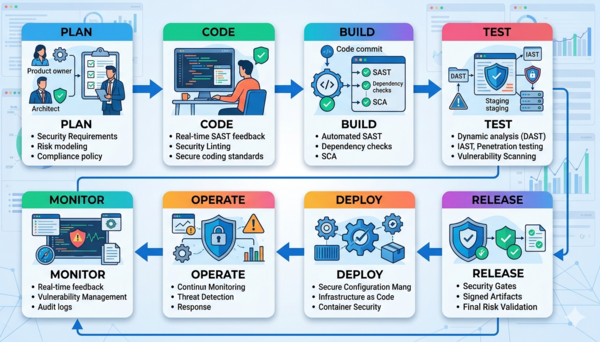
DevSecOps brings security into every phase of the secure software development lifecycle (SDLC), which ensures that applications are built, tested, and deployed with security in mind from the outset.
Integrating security into the development process from the beginning allows teams to accelerate delivery without compromising quality. This approach ensures that both speed and security are prioritized simultaneously.
This transformation allows organizations to move from reactive security measures to proactive risk management aligned with business objectives.
Why DevSecOps Matters for Modern Enterprises
Nowadays, software powers every industry, making application security a global concern.
Secure software in banking and financial services guarantees transaction integrity and safeguards private financial information. It protects consumer interactions and payment systems in retail and e-commerce. To safeguard patient data and guarantee continuous care delivery, healthcare organizations depend on secure applications.
Vulnerabilities can cause major operational disruptions in the manufacturing, logistics, and energy sectors, which rely on software-driven systems for operations and infrastructure management. In the meantime, in order to keep customers' trust, SaaS and technology companies need to strike a balance between quick innovation and strong security. Across all these sectors, DevSecOps provides a consistent framework to reduce risk, improve efficiency, and support regulatory compliance.
Business Benefits of DevSecOps
When organizations truly embrace DevSecOps, the impact goes well beyond the walls of IT and security teams — it shows up in real business results.
Take cost savings, for example. Catching vulnerabilities early in development is significantly cheaper than dealing with them after a product is already live or, worse, in the middle of a security incident. It means less rework, fewer unexpected outages, and ultimately a leaner approach to managing security costs.
Speed is another area where DevSecOps makes a real difference. When CI/CD security checks are automated and baked directly into CI/CD pipelines, teams don’t have to choose between moving fast and staying secure — they get both. In markets where being first matters, that kind of agility can directly influence revenue.
And when it comes to managing risk, DevSecOps helps organizations stay one step ahead. Rather than reacting to breaches after the damage is done, continuous security validation means potential threats are caught and addressed early — protecting the business from financial fallout and keeping operations running without interruption.
On the governance side, DevSecOps takes a lot of the stress out of staying compliant. With continuous monitoring, automated controls, and a clear paper trail built into the process, meeting regulatory requirements becomes far less of a scramble — and when audits come around, organizations are ready rather than rushing to pull things together.
And perhaps one of the most underrated benefits is what DevSecOps does for customer trust. In a world where a single data breach can make headlines and shake confidence overnight, being known for building software securely isn't just a technical achievement — it's a genuine competitive advantage that sets organizations apart.
Aligning DevSecOps with Business Goals
However, for DevSecOps to really deliver on this promise, it must be connected to what the business is actually trying to achieve, as opposed to seeing it as a standalone IT project.
When DevSecOps is aligned with business objectives, it becomes the key to delivering secure digital transformation, scalable and robust applications, eliminating siloed thinking, and advancing innovation without risk. PIT Solutions’ software development services are built around this alignment — helping organizations design DevSecOps frameworks that support long-term business goals rather than acting as a one-size-fits-all technical solution.
When this alignment is in place, security does not become a hindrance, but rather something that the business can rely on in order to grow with confidence.
Transitioning from Traditional SDLC to DevSecOps
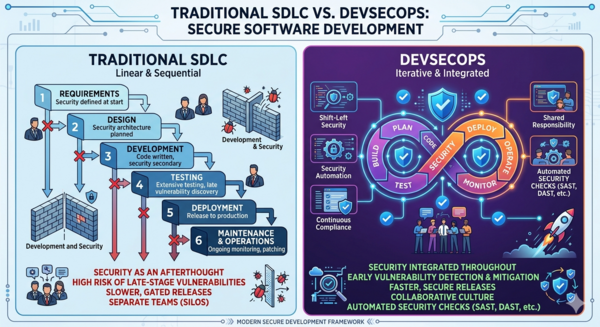
Security is often considered the last check point in conventional software development models, which ultimately results in delays and increased costs. This model is not feasible in environments where continuous delivery is the norm.
With the incorporation of security throughout the entire SDLC, DevSecOps has changed this paradigm. This is achieved through automated security testing, code, and compliance checks, which are integrated throughout the entire software development process, thereby ensuring early detection and resolution of issues.
This has enabled organizations to adopt a continuous security model, which is proactive rather than reactive.
Key Considerations for DevSecOps Implementation
Implementation of DevSecOps requires not only tooling but also operational and cultural changes as well.
It is essential for organizations to establish a culture that promotes shared responsibility for security within the entire organization, including development, operations, and security.
Another critical factor is the aspect of automation. Organizations can achieve greater scalability and consistency by integrating automated CI/CD security testing directly within their pipelines — without needing to grow headcount proportionally. For enterprises looking to strengthen their security posture, PIT Solutions’ cybersecurity services provide expert guidance on toolchain selection and CI/CD security integration.
Another factor is visibility. It is critical for businesses to make proper decisions regarding security threats by having real-time visibility into risks, vulnerabilities, and systems.
Implementation of DevSecOps best practices starting with the areas that have the greatest impact is usually the best way to go
Future of DevSecOps in Enterprise Environments
Of course, technology is constantly evolving, and so is DevSecOps. As AI and analytics are increasingly woven into the fabric of DevSecOps, we are learning how to better identify what is truly important, cutting through all of the noise, and letting automation take care of remediation before problems get out of hand.
What's next for DevSecOps frameworks is a future where security issues are detected and corrected in real-time, with little human interaction, all at a pace of innovation that is uninterrupted.
As we look into the future, DevSecOps is not just a development methodology; it is going to be a part of how we manage risk and build our future.
How PIT Solutions Helps with DevSecOps Implementation
However, DevSecOps has revolutionized the way that organizations look at the development of software and security, and this impact is impossible to overlook. Partnering with PIT Solutions means working with a team that understands how to integrate the secure software development lifecycle into your existing workflows, tools, and business goals. Our approach to DevSecOps implementation is practical, scalable, and tailored to your industry.
When security is integrated into the entire process of software development, the business is able to address security issues before they turn into costly problems, run the business in a lean and efficient way, bring new ideas to the table, meet compliance and governance requirements, and win the loyalty of customers.
In the modern world where software is at the heart of business success, DevSecOps gives the business the confidence to innovate without ever looking back at the security of the business, as the two have now become one.
Ready to Secure Your Software Development Lifecycle?
Enterprise-level DevSecOps adoption calls for a well-defined plan, the right tools, and experienced leadership that understands both the technical and business dimensions of secure software development.
PIT Solutions partners with enterprises to:
-
Assessing your current development and security maturity across the SDLC
-
Designing customized DevSecOps roadmaps aligned with your business objectives and compliance requirements
-
Embedding CI/CD security controls into your existing pipelines and cloud environments
-
Ensuring continuous compliance with standards such as ISO 27001, SOC 2, and GDPR
Whether you’re just starting your DevSecOps journey or looking to mature an existing program, PIT Solutions has the expertise to accelerate your progress safely and sustainably.
Don’t wait for a security incident to force the conversation. Contact PIT Solutions today to explore how a secure software development lifecycle strategy can protect your business, accelerate delivery, and build lasting customer trust.