


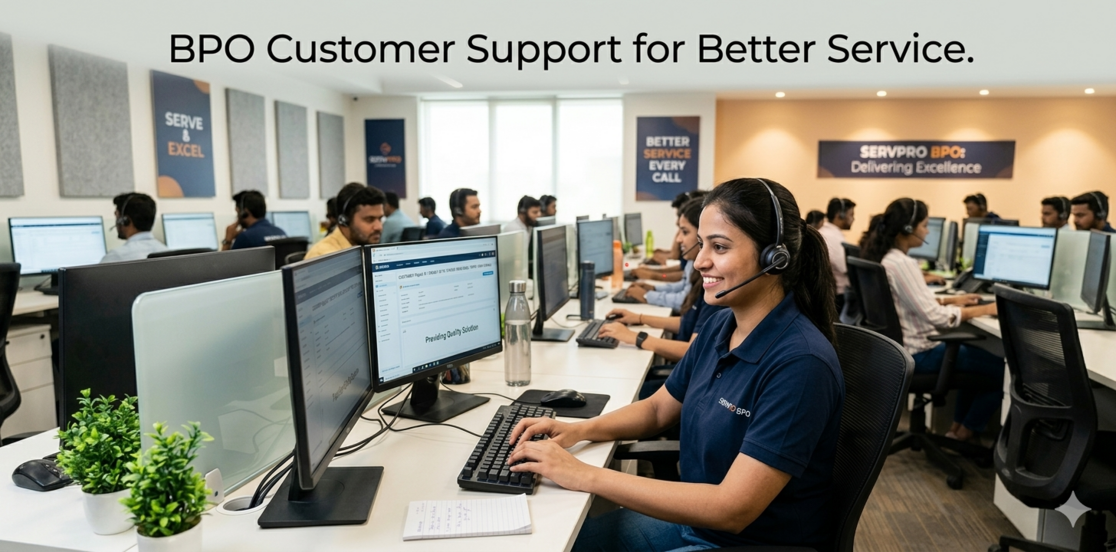
Modern businesses rely on BPO customer support to reduce rising operational costs while maintaining consistent service excellence. As in-house support becomes more expensive, many companies turn to specialized outsourcing partners for stronger efficiency and better customer satisfaction. Outsourced customer support helps organizations use professional contact centers, structured Service-Level Agreements (SLAs), and customer experience management strategies to improve Customer Experience (CX). Through business process outsourcing and support operations optimization, companies balance cost efficiency with service quality in increasingly competitive markets.
Understanding BPO Customer Support and Its Role in Modern Business
Many companies use specialized BPO solutions to manage front-office outsourcing, back-office support, omnichannel support, help desk outsourcing, and technical support outsourcing more efficiently. Through professional call centers, Help Desk Systems, CRM platforms, and ticketing systems, companies handle customer interactions across voice, email, chat, and digital channels smoothly, improving service coordination, speeding issue resolution, and reducing the operational burden of large in-house customer support teams.
What Is BPO Customer Support?
BPO customer support refers to outsourcing customer service functions to specialized third-party providers that handle customer interactions professionally. Its operational scope includes customer inquiries, complaint resolution, technical assistance, order management, and help desk services. Core outsourced support components often include call handling, CRM management, Help Desk Systems, and ticketing system operations.
Types of Customer Support Services Offered by BPO Providers
BPO providers offer voice support for customer calls, email support for structured communication, and live chat support for real-time assistance. Social media customer service assists companies in dealing with customer interaction on electronic platforms. There are also technical support services that offer special troubleshooting, product-oriented guidance, and solutions to issues.
In-House vs Outsourced Customer Support
In-house customer support often involves higher costs for hiring, infrastructure, technology, and workforce management. Outsourced customer support enhances efficiency by having specialized expertise, professional systems, and quicker deployment of services. It is also more scalable, which means that businesses can scale up the support resources according to the growth of the business or seasonal demand.
How BPO Customer Support Reduces Operational Costs
BPO customer support improves BPO cost efficiency through infrastructure savings, workforce management, technology cost reduction, offshore outsourcing, and nearshore outsourcing. Using Workforce Management Systems, Cloud-Based Contact Centers, and Automation Tools, companies reduce operational expenses, improve staffing flexibility, lower internal resource burdens, and maintain scalable customer support without the high financial pressure of traditional in-house operations.
Lower Infrastructure and Technology Costs
- Eliminates office space expenses, utility bills, and facility costs.
- Shared infrastructure reduces hardware and software spending.
- Cloud-Based Contact Centers lower technology ownership costs.
- Provider-managed systems reduce maintenance and upgrade expenses.
Reduced Hiring and Training Expenses
- Access to pre-trained agents reduces hiring delays.
- Lower HR overhead cuts recruitment expenses.
- Outsourcing minimizes onboarding and training investments.
- Workforce Management Systems improve staffing efficiency.
Scalability and Flexible Resource Allocation
- Seasonal demand handling avoids overstaffing costs.
- Pay-as-you-use models support budget flexibility.
- Staffing scales based on operational needs.
- Resource allocation improves service continuity.
Offshore and Global Labor Advantages
- Offshore outsourcing lowers labor costs significantly.
- Nearshore outsourcing balances affordability and accessibility.
- Geographic cost benefits improve budget control.
- Time zone advantages support extended coverage.
Cost Optimization Through Automation
- Chatbots reduce repetitive support workloads.
- AI-driven workflows improve process speed.
- Automation Tools lower manual operational expenses.
- Technology increases efficiency while reducing costs.
How BPO Customer Support Improves Service Quality and Customer Experience
Outsourcing helps businesses improve customer service quality through skilled professionals, multilingual support, 24/7 availability, faster First Response Time (FRT), ticket prioritization, and quicker resolutions. Customer Satisfaction Score (CSAT), Net Promoter Score (NPS), Quality Assurance Processes, Customer Relationship Management (CRM) systems, Quality Monitoring Tools, AI chatbots, and knowledge bases strengthen customer experience optimization through performance tracking and continuous improvement.
Skilled Professionals, Multilingual Support, and 24/7 Availability
Skilled professionals improve service quality through specialized expertise and consistent customer handling. Multilingual support helps businesses serve diverse customer bases across multiple languages and regions effectively. 24/7 availability strengthens customer satisfaction by providing reliable support across all time zones.
Faster Response Times and Measurable Customer Satisfaction
Specialized outsourcing improves First Response Time (FRT) through ticket prioritization and faster issue resolution. Reduced wait times improve customer experience optimization and service efficiency. Customer Satisfaction Score (CSAT) and Net Promoter Score (NPS) measure service quality, satisfaction, and customer loyalty.
Quality Assurance Processes and Technology-Driven Service Excellence
Quality Assurance Processes support performance tracking and continuous improvement for consistent service standards. Customer Relationship Management (CRM) systems and Quality Monitoring Tools improve operational accuracy and support quality. AI chatbots and knowledge bases strengthen efficiency, provide faster assistance, and enable customer service excellence.
Key Business Benefits of BPO Customer Support Beyond Cost Savings
Companies achieve business efficiency improvement through streamlined workflows, reduced workload for internal teams, and better focus on core business functions. Personalized customer experiences, proactive support, and Customer Lifecycle Management improve customer loyalty and long-term retention. Business Intelligence Tools and Analytics Platforms deliver customer insights and performance metrics for better decisions. Business scalability supports rapid growth and expansion, while business continuity ensures stable operations and operational flexibility across changing market demands.
Best Practices for Choosing the Right BPO Customer Support Provider
Choosing a BPO provider requires careful evaluation of vendor reliability, compliance standards, SLA management, and security protocols. Businesses should also consider ISO Certifications, Data Protection Standards, Service-Level Agreements (SLAs), and GDPR Compliance. A structured selection process helps identify a trustworthy outsourcing partner that aligns with operational goals, security requirements, and long-term service performance.
Evaluating Industry Experience and Expertise
Evaluation of industry experience is a good way to make sure that the provider realizes the domain-specific needs and provides the correct solution according to the requirements of the business. A good client success history indicates history of good performance, reliability, and service delivery. Combined, the domain-specific expertise and previous client successes allow businesses to choose a capable partner to carry out complicated support operations confidently and effectively.
Assessing Technology Capabilities
Assessing technology capabilities involves checking CRM integration for seamless customer data management and improved workflow coordination. Automation tools improve efficiency by minimizing human activities and speeding up the response time. Effective technological infrastructure guarantees scalability, precision, and good service delivery so that businesses can operate high-quality customer service functions on several communication channels.
Ensuring Data Security and Compliance
To maintain data security and compliance, it is necessary to comply with privacy regulations, which will safeguard sensitive customer data. Protective infrastructure is used to protect data against unauthorized access, breaches, and vulnerabilities in the infrastructure. These actions establish trust, legality, and safe management of customer interactions by all support systems and digital communication channels.
Reviewing SLAs and Performance Metrics
Reviewing SLAs and performance metrics helps define clear service expectations and accountability standards. KPIs are good measures of performance, response time, and customer satisfaction levels. Guarantees of support can be used to ensure steady service provision and trustworthiness. All these factors allow transparency, better monitoring, and ensure businesses a high-quality customer support performance.
Cost Transparency and Pricing Models
Cost transparency and pricing models make businesses have a clear knowledge of service costs without any hidden costs. Fixed pricing allows predictability in the budgeting process and financial stability, whereas usage-based pricing is flexible depending on the real consumption of the service. These models assist organizations to manage costs effectively and choose support solutions that align with the operational and financial requirements.
Future Trends in BPO Customer Support and Cost Optimization
AI-powered customer support driven by Artificial Intelligence (AI), Machine Learning (ML), Robotic Process Automation (RPA), and Natural Language Processing (NLP) is transforming service delivery through conversational AI, chatbots, and virtual assistants. Predictive analytics, self-service portals, and hyperautomation improve efficiency by reducing manual processes and anticipating customer needs. Omnichannel and digital transformation enable unified customer interactions, enhancing consistency, speed, and overall customer experience across all support channels.
Conclusion
BPO customer service delivers improved service quality, strengthening a business growth strategy. It supports a customer-centric approach by enhancing responsiveness, satisfaction, and consistency while creating a strong competitive advantage. As a long-term strategic decision, it supports digital transformation and improves business competitiveness through scalable support systems and reliable service delivery. PIT Solutions is a Trusted IT Partner delivering proven BPO customer support that boosts efficiency, elevates customer experience, and drives scalable business growth.
Contact Pit Solutions now to experience trusted BPO solutions designed to optimize operations, improve service quality, and support sustainable business expansion.