


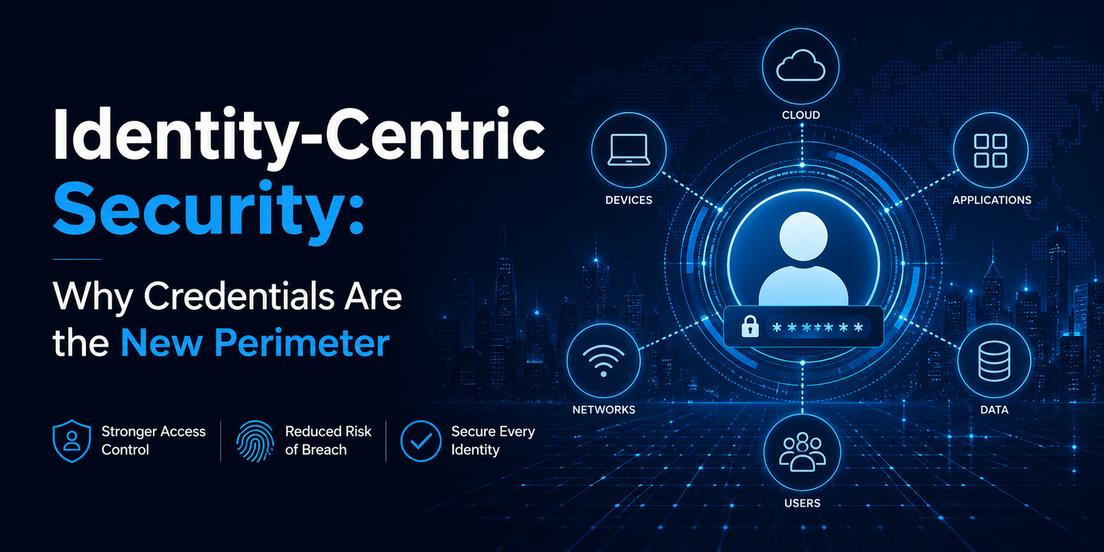
Cybersecurity has entered a decisive inflection point. Traditional defenses built around networks are no longer sufficient in a world driven by cloud, mobility, and distributed workforces. Today, identity-centric security has emerged as the No.1 strategic approach to protect modern enterprises. In our experience, organizations that still rely heavily on network-based defenses are exposed to evolving threats. Based on our research, over 80% of data breaches involve compromised credentials, making identity the most targeted attack vector.
Key drivers behind this shift:
- Collapse of traditional network boundaries
- Rapid adoption of cloud and SaaS platforms
- Rise in remote and hybrid work models
- Increase in identity-based attacks and credential misuse
This is why credentials are the new perimeter and identity-first security is now business-critical.
What is Identity-Centric Security?
Identity-centric security is a modern cybersecurity approach where access decisions depend on verifying a user’s identity rather than their network location. It focuses on continuously validating identities, applying context-aware access control, and enforcing a zero-trust approach where no user or device is trusted by default.
Core Components of Identity-Centric Security
● IAM (Identity and Access Management)
IAM helps organizations create and manage user identities in a structured way. It ensures that the right users get the right level of access to systems and data. It also simplifies operations by automating user onboarding when employees join and removing access when they leave, reducing security risks.
● PAM (Privileged Access Management)
PAM focuses on securing high-level accounts, such as administrators, who have critical control over systems. It monitors how these accounts are used, tracks sessions, and prevents misuse or unauthorized actions that could lead to major security breaches.
● MFA (Multi-Factor Authentication)
MFA adds an extra layer for your digital identity protection by requiring users to verify their identity using more than just a password. This can include OTPs, biometrics, or device-based verification, making it much harder for attackers to gain access even if credentials are compromised and strengthening credential security.
● Supporting Capabilities
Technologies like Single Sign-On (SSO) improve user experience by allowing access to multiple applications with one login. Identity federation enables secure access across different systems or organizations, while access lifecycle management ensures user permissions are regularly updated and controlled.
Traditional Perimeter-Based Security Architecture
Earlier enterprise environments depended heavily on network perimeter security. Firewalls, VPNs, and intrusion detection systems created a boundary that defined trust.
How it worked:
- Firewalls controlled inbound and outbound traffic
- VPNs secured remote access
- IDS/IPS monitored suspicious activity
- DMZ architecture isolated public-facing systems
This model assumed that users inside the network were trustworthy.
Limitations in today’s environment:
- Insider threats bypass perimeter controls
- Attackers move laterally once inside
- Remote access expands vulnerability
- Cloud environments dissolve network boundaries
In our findings, perimeter-based models fail because trust is granted too early and verified too late.
The Rise of Identity as the New Security Perimeter
Today, people work from anywhere, from home, mobile devices, or cloud apps, so traditional network boundaries no longer protect systems effectively. In our experience, this change means security can no longer depend on location. Instead, organizations focus on verifying who the user is before giving access. This is why identity-based cybersecurity has become the new standard, where authentication and authorization control access, making identity the new security perimeter.
Why Credentials Are the New Perimeter in Modern Cybersecurity
Rise of Credential-Based Cyberattacks
Attackers no longer break systems; they log in.
Common attack methods include:
- Phishing attacks
- Credential stuffing
- Password spraying
- Brute-force attacks
Based on our research, identity-based attacks have surged because credentials are easier to exploit than infrastructure.
Targets include:
- Passwords
- API tokens
- Authentication keys
Impact of Cloud Computing and Remote Workforce
Cloud adoption has fundamentally changed access patterns:
- Multiple login endpoints
- Increased exposure surface
- No fixed network boundary
This makes cloud identity security and remote workforce security critical priorities.
Identity now acts as the universal access gateway across:
- SaaS platforms
- Hybrid environments
- BYOD ecosystems
Core Principles of Identity-Centric Security
Zero Trust Architecture
Zero Trust follows the concept of “never trust, always verify,” as defined by the NIST Zero Trust Framework. It requires continuous identity validation, monitors user sessions in real time, and uses adaptive authentication to ensure that every access request is verified, regardless of where it originates.
Least Privilege Security
Least privilege ensures that users, applications, and systems only get the minimum access required to perform their tasks. This approach reduces the attack surface, limits unnecessary permissions, and helps prevent misuse of access rights or accidental data exposure.
Behavioral Authentication and Identity Monitoring
This principle focuses on continuously tracking user behavior, device trust levels, and access patterns. By analyzing these factors, organizations can quickly detect unusual activities, prevent unauthorized access, and strengthen overall identity governance.
Key Technologies Enabling Identity-Centric Security
Identity and Access Management (IAM) Systems
IAM platforms centralize identity control across the organization. They handle authentication to verify users, authorization to define access levels, and provisioning to manage user accounts efficiently throughout their lifecycle.
Multi-Factor Authentication (MFA)
Passwords alone are no longer secure. MFA strengthens protection by requiring additional verification, such as biometrics, one-time passwords, or trusted devices, making unauthorized access much harder.
Privileged Access Management (PAM)
PAM protects critical systems by controlling and monitoring high-level accounts. It tracks admin sessions, limits privileged access, and prevents misuse that could lead to major security risks.
Identity Governance and Administration (IGA)
IGA focuses on managing identity policies and ensuring proper access control. It supports identity lifecycle management, enforces governance rules, and helps organizations stay compliant with security standards.
Benefits of Identity-Centric Security for Enterprises
Improved Security Posture
It reduces the attack surface by limiting unnecessary access. It also strengthens identity threat protection by focusing on securing user credentials.
Reduced Insider Threat Risks
It tracks user access and monitors behavior continuously. This helps detect and prevent misuse by internal users.
Enhanced Compliance
It supports regulatory standards like GDPR and ISO 27001. It also maintains audit-ready logs for better visibility and control.
Improved User Experience
It enables faster access through SSO. Users get a smooth and seamless authentication experience across systems.
Identity-Centric Security vs Traditional Perimeter Security
|
Feature |
Perimeter security |
Identity security |
|
Trust model |
Network based |
Identity based |
|
Access control |
Static |
Dynamic |
|
Risk detection |
Limited |
Continuous |
|
Cloud readiness |
Weak |
Strong |
|
Security focus |
Infrastructure |
Identity |
Common Identity Threats Organizations Must Address
Credential Theft
Attackers exploit phishing, weak passwords, and data leaks to gain access to user accounts. These stolen credentials are often reused across systems, increasing the risk of widespread breaches.
Privilege Escalation
Unauthorized access to higher privileges leads to system compromise. Attackers use this access to control critical systems and access sensitive data.
Insider Threats
Malicious or negligent users pose internal risks. Lack of proper monitoring and access control can make these threats harder to detect.
Identity-Based Ransomware
Attackers hijack identities to lock systems, demand ransom, and spread laterally across networks. This type of attack can quickly disrupt operations and cause major financial losses.
Best Practices for Implementing Identity-Centric Security
Enforce Multi-Factor Authentication
Enable MFA for all users to add an extra layer of security beyond passwords. This reduces the risk of unauthorized access even if credentials are compromised.
Apply Least Privilege Access
Grant users only the access they need to perform their tasks. This limits exposure and prevents misuse of sensitive systems or data.
Monitor Identity Activity Continuously
Track user behavior and login activity using advanced identity monitoring tools. This helps detect suspicious actions early and respond quickly.
Adopt Zero Trust Architecture
Follow a “never trust, always verify” approach for every access request. This ensures continuous validation of users and devices.
Conduct Identity Risk Assessments
Regularly evaluate identity-related risks across systems and users. This helps identify vulnerabilities early and strengthen overall security.
Real-World Use Cases of Identity-Centric Security
● Securing remote workforce access
Ensures employees can safely access company systems from any location by verifying identity and device trust. This reduces risks linked to unsecured home networks and remote logins.
● Protecting SaaS applications
Controls who can access cloud-based tools like CRM or email platforms through strong authentication. This prevents unauthorized logins and protects sensitive business data.
● Managing third-party/vendor access
Gives limited and controlled access to external partners based on their role and need. This minimizes security risks from external users and prevents over-permissioning.
● Securing cloud environments
Applies identity checks across cloud platforms to control access to data and applications. This ensures only verified users can interact with critical cloud resources.
In our findings, organizations adopting modern identity security experience fewer breaches and stronger overall protection.
Challenges in Implementing Identity-Centric Security
Implementing identity-centric security comes with several challenges, including integrating with legacy systems that are not designed for modern identity frameworks and managing complex identity ecosystems across cloud and on-prem environments. Organizations may also face user resistance to new authentication methods like MFA, along with a shortage of skilled professionals to manage identity systems effectively. Despite these challenges, in our experience, adopting an identity-first security approach is essential to staying protected in a cyber threat environment.
Future Trends in Identity-Centric Security
Passwordless Authentication
● Biometric-based login
Uses fingerprints or facial recognition to verify users quickly and securely without needing passwords.
● Elimination of passwords
Removes password risks like theft or reuse, making access simpler and more secure.
AI-Driven Identity Protection
● Predictive threat detection
Uses AI to identify unusual behavior early and stop potential attacks before they happen.
● Automated response systems
Automatically reacts to threats by blocking access or triggering security actions in real time.
Machine Identity Management
● Securing APIs and non-human identities
Protect applications, bots, and APIs by verifying their identities before access is granted.
● Managing service-to-service authentication
Ensures secure communication between systems by controlling how services authenticate with each other.
Conclusion
Identity is no longer just a part of security; it is the foundation of modern cybersecurity. In our experience, organizations that adopt identity-first cybersecurity achieve stronger protection, better compliance, and improved operational efficiency. Credentials have become both the most valuable and most vulnerable asset, which makes identity-centric security the No.1 priority for modern enterprises. To stay ahead of evolving threats, businesses should focus on strengthening identity governance, enabling continuous authentication, and implementing Zero Trust strategies.
If you are looking for a trusted IT Partner, choosing an experienced Cybersecurity company with proven capabilities in Cyber security can help you secure your digital environment effectively.