



Payment integration is one of the most complex and business-critical aspects of an eCommerce platform. A failed payment does not just block checkout—it impacts revenue, customer trust, support overhead, and downstream processes like invoicing, refunds, and reconciliation. As online transactions grow more complex, businesses need a structured and secure payment integration approach that ensures stability, scalability, and compliance.
This article explains Magento 2’s payment gateway architecture in practical terms and then walks through a Datatrans payment integration as a real-world case study.
What Is Magento 2 Gateway Architecture?
Magento 2 Gateway Architecture is a modular, command-based framework that standardizes Magento 2 payment integration. Instead of embedding API calls directly into controllers or order models, Magento structures payment processing into coordinated components that execute in a defined sequence.
Payment actions such as authorization, capture, refund, and void are triggered through commands, which delegate tasks to request builders, gateway clients, validators, and response handlers. This separation ensures controlled transaction handling, predictable error management, and easier customization.
Why Gateway Architecture Matters for Payment Integrations
Payment integrations introduce challenges that go far beyond sending an HTTP request to a provider:
- Payment providers follow different API standards and flow models
- Many payment methods are asynchronous (redirects, delayed confirmations, webhooks)
- Order state must remain consistent across retries, failures, and partial updates
- Sensitive data must be handled securely and logged responsibly
- Integrations must survive Magento upgrades and provider API changes
A structured Magento 2 payment integration built on the official gateway architecture ensures predictable behaviour, improved maintainability, and stronger operational resilience across both Magento Open Source and Adobe Commerce payment integration environments.
Key Components of Magento 2 Payment Gateway
Magento 2’s payment gateway architecture is composed of several well-defined components that collaborate during payment processing. The design follows SOLID principles and uses dependency injection extensively, which keeps implementations modular and testable. Core components are listed below.
Gateway Command Pool
- Acts as a central registry for all payment-related commands
- Maps payment operations such as authorize, capture, refund, and void to concrete command implementations
- Allows Magento to dynamically select the correct command based on checkout flow or order lifecycle
- Enables safe extension or replacement of individual payment operations
Gateway Commands
- Represent a single, well-defined payment operation
- Coordinate request building, execution, and response processing
- Keep payment logic out of controllers and models
- Follow the Command pattern, improving testability and reuse
Request Builders
- Assemble the data payload sent to the payment provider
- Collect information from the quote or order, customer context, and store configuration
- Format data according to provider requirements
- Enforce single-responsibility design for maintainable request construction
Gateway Client
- Acts as the communication layer between Adobe Commerce and the payment provider
- Creates and consumes transfer objects that contain the endpoint, HTTP method, headers, and payload
- Executes HTTP requests and retrieves responses from the payment processor
- Handles authentication and environment-specific endpoint selection
- Centralizes all transport and communication logic across payment commands
Validators
- Validate that gateway responses are complete and consistent
- Ensure mandatory fields such as transaction IDs are present
- Stop the payment flow immediately and raise a controlled exception if validation fails
Response Handlers
- Translate gateway responses into Magento payment and order updates
- Set transaction and Update payment additional information
- Move orders into the appropriate state and status
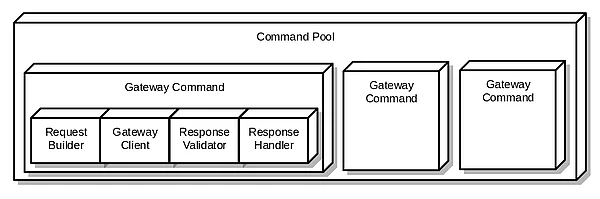
The Request–Response Flow
When a customer completes checkout, Magento 2 Payment Integration orchestrates a sophisticated flow:
- The payment method calls the appropriate gateway command from the command pool
- Request builders gather and format the necessary data
- The transfer factory creates the transfer object with the complete request
- The gateway client sends the HTTP request to the payment provider
- Response validators verify the response integrity
- Response handlers process the response and update order status
- The system logs transaction details for auditing and debugging
This flow ensures that each step has a single responsibility and that failures are detected early and handled consistently.
Datatrans Integration Overview
Datatrans is a well-established European payment service provider that supports a wide range of payment methods, including credit cards, digital wallets, and regional schemes Its flexible API and multi-method capabilities make it an excellent real-world example of how Magento 2 Payment Integration can be implemented effectively using the platform’s native gateway architecture — without excessive customization or tightly coupled logic.
By aligning with Magento’s structured design, the integration maintains a clear separation of concerns while promoting consistent and secure payment integration practices across all supported payment methods.
Multiple Payment Methods, Shared Architecture
In the Datatrans module, each payment method is exposed as a separate Magento payment option. From a merchant’s perspective, this allows independent configuration and availability rules. From a technical perspective, however, these methods share a common foundation.
Instead of duplicating logic, the integration uses a shared command pool for core operations such as initialization, capture, refund, and cancellation. This keeps payment behaviour consistent across methods while still allowing method-specific validation and configuration.
The result is a structure where adding a new Datatrans payment method becomes a configuration and validation exercise rather than a full architectural rewrite.
Structured Request Building
Datatrans payment initialization requires assembling data from multiple sources: order totals, redirect URLs, customer context, and payment configuration. Rather than building this payload in a single class, the module uses a composite request builder.
Each sub-builder focuses on a specific concern, such as amounts, redirects, or customer information. This design keeps request construction readable and maintainable. Changes to one aspect of the request—such as how amounts are formatted or how redirects are generated—do not risk breaking unrelated logic.
This approach also improves testability, as individual builders can be validated in isolation.
HTTP Communication and Security Considerations
The Datatrans HTTP Client encapsulates all API communication with the payment provider. It handles endpoint selection, authentication, and request execution while supporting multiple HTTP methods such as POST for transaction creation, GET for status queries, and DELETE for cancellations. By centralizing transport concerns like timeouts, retries, and error normalization, the client ensures consistent and predictable behaviour across all payment operations.
Validation and Error Handling Strategy
Payment failures are inevitable, but unclear or late failures are costly. The Datatrans integration applies validation at multiple stages. Before a request is sent, configuration validators ensure that the payment method is available for the current store context, currency, and country. After a response is received, response validators confirm that the payment state is meaningful and consistent with the expected operation.
This layered validation prevents invalid transactions from reaching later stages of order processing and helps surface actionable error messages for both merchants and customers.
Asynchronous Flows and Webhooks
Like many modern payment providers, Datatrans relies on asynchronous notifications for certain payment states. Webhooks play a crucial role in keeping Magento’s order state synchronized with the provider.
The integration includes a webhook handler that validates incoming notifications, updates order and transaction state, and avoids race conditions when redirects and webhooks arrive close together. This ensures reliable order updates even in non-linear payment flows.
Logging for Production and Debugging
A clear logging strategy is essential for operating payment systems in production. The Datatrans module separates critical error logging from detailed debug logging.
Operational logs capture failures that require attention, while debug logs provide deeper insight into request and response flows when troubleshooting is needed. This balance avoids cluttering production logs while still enabling effective debugging when issues arise.
Testing and Long-Term Maintenance
Thorough testing in sandbox environments is essential. Use the payment provider's sandbox environment extensively. Consider all payment operations, edge cases, and error scenarios. Test various payment methods, amounts, and currencies. Verify refunds, voids, and captures work correctly across different order states.
Long-term maintenance is unavoidable. Payment providers evolve APIs, and Magento itself introduces architectural changes over time. A gateway-based integration significantly reduces the cost of these changes by localizing updates to specific components instead of spreading them across the codebase.
How PIT Solutions Enables Secure Magento Integrations
At PIT Solutions, we deliver secure and scalable Magento 2 Payment Integration services using an architecture-driven approach. Our expertise in custom Magento integrations ensures stable transaction processing, safe handling of asynchronous flows, and strict response validation. We design solutions that remain compatible with evolving Magento versions and changing payment provider APIs.
We also offer a robust Datatrans Payment Integration for Magento 2, built for controlled transaction handling and long-term upgrade readiness. To explore our Magento payment solutions or discuss your requirements, connect with PIT Solutions