


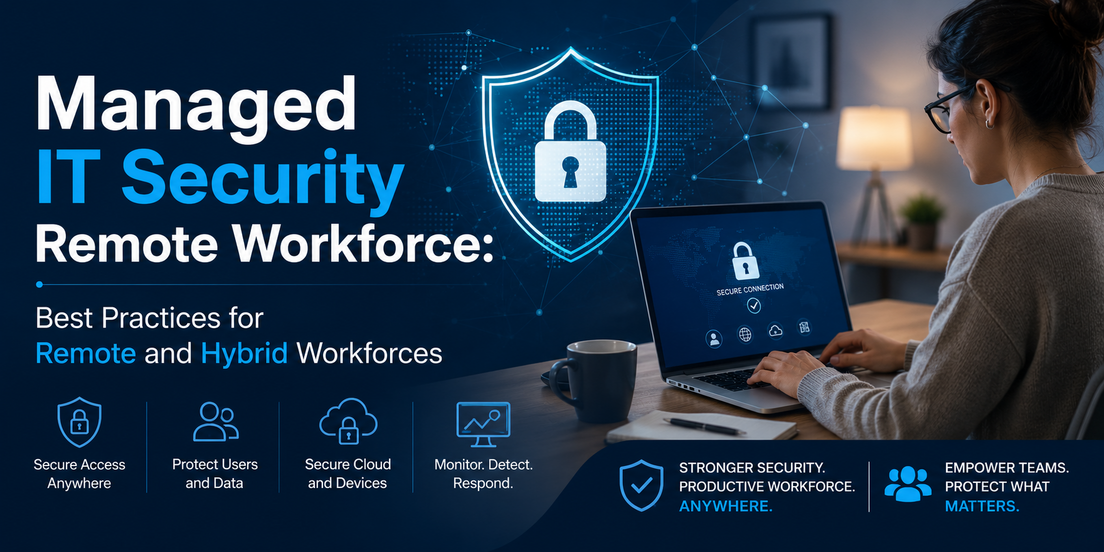
Remote and hybrid work have expanded business flexibility, but they have also increased exposure to cyber threats. With employees accessing systems from different locations and devices, the traditional corporate perimeter no longer exists. As a result, managed IT security remote workforce strategies have become a business-critical priority rather than a responsibility limited to the IT team. Improving remote workforce security protects business data, ensures safe day-to-day operations, and reduces the chances of security risks. This article explores key best practices for protecting today’s distributed workforce effectively.
Understanding the Cybersecurity Challenges of Remote and Hybrid Workforces
Remote & hybrid environments introduce remote work security challenges through decentralised networks, personal devices & cloud dependency. Weak home network security increases remote access vulnerabilities and employee cybersecurity risks. Bring Your Own Device (BYOD) extends exposure across endpoints. Heavy use of Cloud Computing and SaaS Applications raises cloud security concerns. Shadow IT and insider threats further weaken digital workplace security, requiring stronger controls and continuous protection across distributed systems.
Why Managed IT Security Is Essential for Modern Workforces
A Managed Security Service Provider (MSSP) basically delivers 24/7 threat monitoring to help shield distributed environments from attacks that keep evolving. They rely on Security Information and Event Management (SIEM) to simplify risk management through real-time visibility and alerting. A Security Operations Center, or SOC, keeps security operations running continuously so detection and response can happen faster. With managed detection and response plus threat intelligence, businesses strengthen compliance management, incident response, and overall proactive protection across today’s remote and hybrid workforces.
The Most Common Cyber Threats Targeting Remote and Hybrid Employees
Remote & hybrid workers get hit with phishing, ransomware, Business Email Compromise (BEC), credential stuffing, man in the middle attacks, spyware, trojans and it can quickly escalate into credential theft, social engineering, malware attacks, and data breaches, frequently. These threats use any loose device and network they can find, so exposure feels higher for distributed teams, even when employees follow security best practices. And the fallout isn’t small; financial losses show up, operations get slowed or disrupted, reputation takes a hit, and sensitive data is at risk, so strong security controls are really essential.
Establishing a Zero Trust Security Framework for Distributed Teams
Zero Trust Security is a foundational architecture for remote and hybrid workforces where no user or device is trusted by default. It requires periodic verification, strict access control, and robust identity management to limit exposure in a distributed world via least privilege access. This way, we avoid letting users access resources they may not be authorized to access and reduce the potential for breaches. The technologies include Zero Trust Network Access (ZTNA), Identity and Access Management (IAM), Single Sign-On (SSO), and Conditional Access, which help to improve and enhance the authentication and secure modern workforce operations.
Strengthening Identity and Access Management (IAM)
Identity and Access Management (IAM) really strengthens security for remote, and hybrid work setups by managing who can get into systems and data. It covers MFA implementation, solid password protection, user provisioning and role-based access control, to minimise those unauthorised usage chances. In practice, these approaches make sure that each person only gets the permissions they actually need. Leading IAM platforms and privileged access management solutions and Privileged Access Management (PAM) help by keeping authentication centralized, enforcing access policies, and protecting sensitive systems across a more distributed, sometimes scattered, workforce.
Securing Endpoints Across Remote and Hybrid Work Environments
Endpoint security is essential for protecting laptops, desktops, smartphones, and tablets used in remote and hybrid work settings. Organizations strengthen defenses through device hardening, endpoint monitoring, antivirus protection, and mobile device security to reduce vulnerabilities and prevent breaches. Modern solutions such as Endpoint Detection and Response (EDR) and Extended Detection and Response (XDR) provide real-time threat visibility and response. Platforms like Microsoft Defender, CrowdStrike, and Sentinel help secure endpoints, detect malicious activity, and protect distributed workforces from evolving cyber threats.
Implementing Secure Remote Access Controls
- Secure remote access is achieved by enforcing strong policies that control how employees connect to corporate systems from remote locations.
- Secure connectivity solutions like VPN and Secure Access Service Edge (SASE) help protect data in transit and reduce exposure to external threats.
- Network segmentation limits access between systems, ensuring users only reach authorized resources within the network.
- Remote access management tools help IT teams monitor, control, and audit user connections in real time.
- Access governance ensures permissions are assigned based on roles and reviewed regularly to prevent excessive access rights.
- Technologies such as Software Defined Perimeter (SDP) and Zero Trust Network Access (ZTNA) strengthen secure remote access by enforcing identity-based authentication and reducing attack surfaces.
Protecting Cloud Applications and Collaboration Platforms
Cloud-based tools are widely used in remote and hybrid work setups, making cloud access security a key concern for organizations. Protecting Microsoft 365, Google Workspace, Slack & Zoom requires strict data protection policies, secure sharing settings, and controlled access to avoid leaks and misuse. Secure collaboration depends on encryption, identity verification, and monitoring user activity across platforms. Strong cloud governance guarantees compliance, policy enforcement and visibility, while a Cloud Access Security Broker (CASB) helps monitor, manage and secure cloud apps across distributed work environments.
Building a Strong Employee Cybersecurity Awareness Program
Human mistakes remain a major cause of security incidents in remote and hybrid environments, making Security Awareness Programs essential for reducing risk. These programs build a strong security culture by training employees on phishing
awareness, cyber hygiene, and safe handling of sensitive data. Regular Phishing Simulations help users recognize real attacks, while education on Social Engineering strengthens their ability to avoid manipulation. Together, these efforts turn employees into a reliable human firewall that supports overall cybersecurity defenses.
Data Protection Best Practices for Remote & Hybrid Workforces
Protecting sensitive business data across remote and hybrid work environments requires strong data encryption, secure access controls, and clear data governance policies. Organizations use secure file sharing methods to ensure information is exchanged safely between employees and systems. Data Loss Prevention (DLP) solutions help prevent accidental or intentional data leaks, while AES Encryption protects stored and transmitted information. Tools like Secure File Transfer Protocol (SFTP) and Information Rights Management (IRM) further secure data regardless of employee location.
The Role of Continuous Monitoring and Threat Detection
- Threat detection is strengthened through continuous real-time monitoring of networks, endpoints, and user activity to identify suspicious behavior early.
- Threat intelligence helps organizations understand emerging attack patterns and proactively defend against potential risks.
- Security analytics powered by SIEM enables correlation of logs and events for faster incident detection.
- A SOC (Security Operations Center) provides centralized monitoring and rapid response to security alerts.
- User and Entity Behavior Analytics (UEBA) detects abnormal user activity that may indicate compromised accounts or insider threats.
- Threat Hunting involves proactive investigation of hidden threats before they escalate into major security incidents.
Incident Response and Business Continuity Planning for Distributed Workforces
Effective cyber incident management ensures organizations can respond quickly to security breaches in remote and hybrid environments. The NIST Incident Response Framework guides preparation, detection, containment, and recovery to minimize damage. A well-defined Disaster Recovery Plan (DRP) supports disaster recovery by restoring critical systems and data after disruptions. A Business Continuity Plan (BCP) strengthens operational resilience and supports recovery planning, ensuring essential business functions continue during cyber incidents or system failures across distributed workforces.
Compliance and Regulatory Considerations for Remote Workforce Security
- Governance policies help organizations enforce consistent security rules across remote and hybrid employees, regardless of location or device.
- Compliance audits ensure systems and user activities align with required security regulations and internal standards.
- Strong data privacy management protects sensitive information and supports legal compliance across distributed work environments.
- Frameworks like GDPR and HIPAA guide how personal and health data must be handled securely.
- Standards such as ISO 27001 and PCI DSS define structured controls for information security and payment data protection.
- The NIST Cybersecurity Framework provides a comprehensive approach to managing and improving cybersecurity risk across remote workforces.
Emerging Technologies Transforming Remote Workforce Security
Emerging technologies are transforming AI in cybersecurity by strengthening protection for remote and hybrid workforces. Artificial Intelligence (AI) and Machine Learning (ML) enable advanced machine learning security through automated threat detection and faster response to evolving attacks. Behavioral analytics improves visibility into user activity, helping identify anomalies early, while predictive security anticipates risks before they occur. Tools like Security Orchestration, Automation and Response (SOAR) streamline incident workflows, and Generative AI enhances threat analysis, detection accuracy, and overall cyber defense capabilities.
Creating a Comprehensive Managed IT Security Strategy for Remote and Hybrid Workforces
A strong cybersecurity strategy for remote and hybrid workforces helps organizations improve security maturity and build a resilient cyber defense framework. It ensures consistent protection across people, processes, and technology.
Step 1: Assess Current Security Risks
Organizations begin by identifying vulnerabilities across devices, networks, and user behavior. This helps establish a clear baseline for a strong risk mitigation strategy.
Step 2: Define Security Policies and Governance
Clear policies are created to control access, compliance, and user responsibilities. This ensures consistent enforcement of security standards across remote environments.
Step 3: Implement Zero Trust Controls
Zero Trust ensures every access request is continuously verified before approval. This reduces unauthorized access and strengthens the overall security posture.
Step 4: Secure Endpoints and Networks
All devices and connections are protected using layered security measures. This prevents attackers from exploiting remote access points and unsecured networks.
Step 5: Enhance Employee Security Awareness
Employees are trained to identify threats such as phishing and social engineering. This reduces human error and strengthens frontline defense.
Step 6: Deploy Continuous Monitoring
Real-time monitoring tools detect suspicious activity across systems and users. This improves response time and enhances visibility into threats.
Step 7: Test Incident Response Readiness
Organizations run simulations to evaluate response speed and effectiveness. This ensures teams are prepared to handle real cyber incidents.
Step 8: Measure and Improve Security Posture
Security performance is regularly reviewed using defined metrics and assessments. This enables ongoing security optimization and long-term resilience.
Key Metrics to Measure Remote Workforce Security Effectiveness
Measuring Mean Time to Detect (MTTD) and Mean Time to Respond (MTTR) helps organizations gauge how fast threats are flagged and dealt with in remote environments. These KPIs matter a lot for making security posture assessment better and for cutting down risk exposure across distributed systems. Compliance metrics make sure there’s adherence to security standards and regulations, while Security Scorecards provide a clear view of overall performance. Risk Assessment Frameworks back a more structured evaluation of vulnerabilities and help track positive movement in remote workforce security effectiveness.
Future Trends in Managed IT Security for Hybrid Work Environments
Managed IT security is evolving toward AI enabled cybersecurity, where systems notice and answer threats quicker, with less human involvement. Passwordless authentication based on biometrics is increasingly replacing traditional passwords, reducing the risk of credential theft. Additionally, autonomous security operations powered by automation help improve threat response and reduce manual workloads across distributed environments. Meanwhile, SASE and Zero Trust 2.0 are shaping a more adaptive, identity-first kind of security model, so teams can build safer digital workplaces that can scale with the hybrid workforce demands.
Conclusion
A proactive managed IT security remote workforce approach is essential for protecting modern organizations against evolving cyber threats. By combining advanced technology, strong governance, employee awareness, compliance practices, and continuous monitoring, businesses can significantly improve remote workforce security and reduce risk across distributed environments. This integrated strategy ensures resilience, faster threat response, and stronger overall protection for remote and hybrid teams. To stay ahead of attackers, organizations must adopt a unified, always-on security mindset powered by trusted expertise.
Contact PIT Solutions now and secure your digital future with confidence—don’t wait for a breach to define your response, take control before threats take control of you.