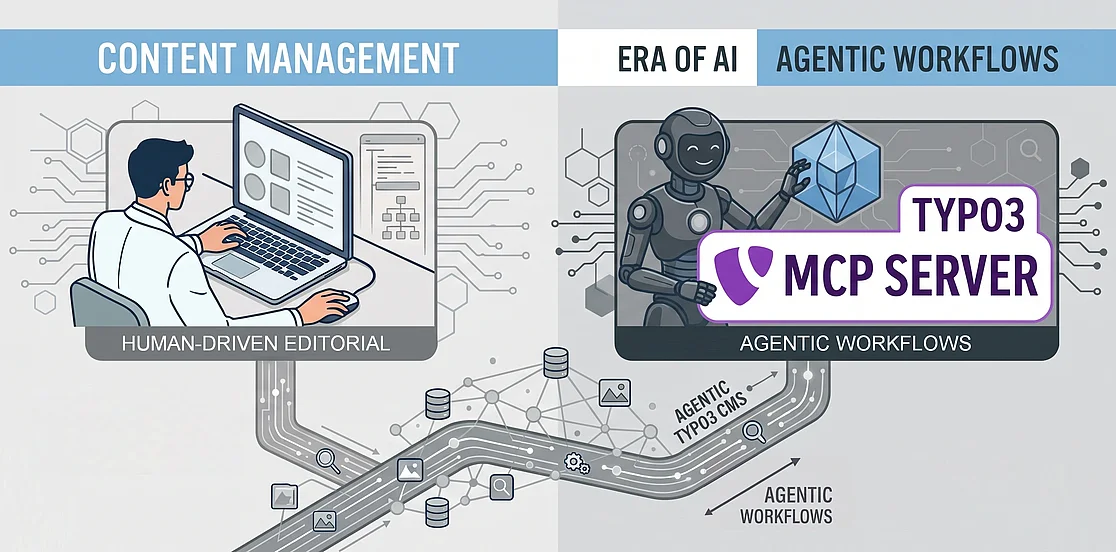
The conversation around generative AI in enterprise content management has matured. We have moved past simple prompt-engineering hacks and browser copy-pasting ("draft me a 300-word paragraph about our new service"). Today, engineering and digital teams are asking a more critical architectural question: How do we enable AI agents to autonomously inspect, create, curate, and maintain content inside our enterprise CMS safely and reliably?
In enterprise CMS ecosystems, direct database injections or unvetted scripts break data integrity, ignore permission trees, and bypass editorial workflows. This is where the Model Context Protocol (MCP) and the official TYPO3 MCP Server extension enter the picture. In this guide, we explore how editorial operations evolve in the era of generative AI, why traditional APIs fall short, how MCP bridges the agentic gap, and how to configure the community-funded extension to manage TYPO3 content and digital assets with expert backing from PIT Solutions.
What is the TYPO3 MCP Server?
The TYPO3 MCP Server is a specialized backend extension (hn/typo3-mcp-server) that exposes a Model Context Protocol interface directly to AI models like Claude or ChatGPT. Rather than treating the CMS as a passive file store or relying on static headless endpoints, the MCP server acts as an intelligent bridge. It translates natural language goals into secure, structured tool calls that interact with the core TYPO3 framework.
Why AI-Powered Content Management Needs MCP
Enterprise content management has historically been governed by structured, human-driven data entry. The shift toward agentic AI does not eliminate human governance; rather, it fundamentally redefines how tasks are executed.
| Concern / Phase | Pre-Generative AI Era | Generative AI & Agentic Era |
|---|---|---|
| Content Drafting | Manual authoring in Rich Text Editors (RTE); external drafting in docs. | Context-aware AI generation adhering to localized brand voice and schemas. |
| Media Handling | Manual uploads, focal cropping, and manual alt text typing. | Multimodal models analyzing assets, generating metadata, and embedding media. |
| Localization & SEO | Manual translation rounds or one-to-one deep-link dictionary lookups. | Dynamic, culture-aware localization and autonomous metadata gap remediation. |
| Site Governance | Periodic manual link audits and content freshness reviews. | Autonomous agent sweeps detecting out-of-date records, orphan pages, and broken flows. |
Why can’t AI agents just call existing REST or GraphQL endpoints? Standard headless APIs are built for frontend rendering or CRUD integration, not for reasoning loops. Furthermore, passing raw, uncurated API schemas or binary data consumes massive token volumes, driving up latency and infrastructure costs. Crucially, generic integrations often run under an all-powerful service token, bypassing backend user rights and workspace isolation. MCP solves these challenges by providing uniform tool contracts, strict least-privilege scoping, and optimized context management.
What Is the Model Context Protocol?
Introduced as an open standard by Anthropic, the Model Context Protocol (MCP) functions like an open "USB-C port" connecting AI clients (Claude Desktop, Cursor, local agent runners, ChatGPT) to external systems such as databases, repositories, and enterprise platforms.
MCP standardizes three key capabilities:
- Prompts: Pre-configured prompt templates exposed by the server.
- Resources: Contextual, read-only data feeds (like page trees, record structures, or logs).
- Tools: Executable functions that the model can invoke (like creating a record, reading a table, or uploading a file).
How the TYPO3 MCP Server Manages Content
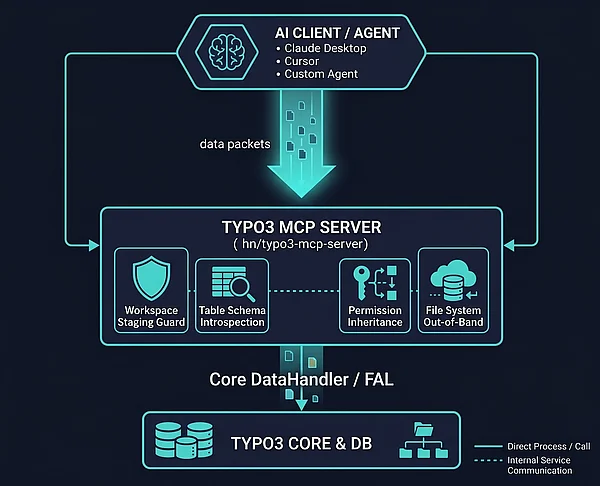
When connected to TYPO3 via MCP, the AI model engages in a continuous reasoning and tool execution loop:
Goal → Query Schema / Discover Context → Execute Tool → Inspect Staged State → Finalize
Through TYPO3 Development and system integration practices, developers can leverage tools like GetTableSchema to understand TCA definitions dynamically, and WriteTable to stage records securely into isolated workspaces before publishing.
TYPO3 MCP Server and Editorial Workflows
AI editorial workflows require absolute safety nets. When an agent creates new tt_content records or edits page properties via the MCP Server, it writes to an isolated TYPO3 Workspaces staging layer. Human editors can visually preview, diff, and approve changes before anything goes live, ensuring zero production disruption.
How MCP Improves AI Agent Accessibility in TYPO3
AI agents face accessibility barriers when interacting with enterprise software just as humans do. Traditional administrative user interfaces are built for mouse clicks and visual navigation—environments where autonomous models struggle. MCP provides an API-first accessibility layer, offering deterministic navigation through trees, semantic constraint validation against TCA rules, and clear feedback loops that enable agents to self-correct on validation errors.
How to Set Up the TYPO3 MCP Server
The community-recognized extension mcp_server (Composer package: hn/typo3-mcp-server) provides an out-of-the-box MCP server for TYPO3 13 LTS and 14 LTS.
Prerequisites
- TYPO3 13.4 LTS or 14 LTS
- PHP 8.2+
- TYPO3 Core System Extension workspaces installed and active
Step 1: Install via Composer
Run the following command in your TYPO3 root directory:
    Bash
    composer require hn/typo3-mcp-server
Step 2: Configure Transport and Backend Authentication
The extension supports both Local Standard I/O (stdio) and HTTP Transport with OAuth / Static Tokens.
Option A: Local CLI / Stdio (Recommended for Local Dev & Claude Desktop)
For local development using tools like DDEV or native PHP, you can configure your MCP client to invoke the TYPO3 CLI directly.
In your client configuration (e.g., claude_desktop_config.json):
JSON
{
  "mcpServers": {
    "typo3-local": {
      "command": "ddev",
      "args": [
        "exec",
        "vendor/bin/typo3",
        "mcp:server"
      ]
    }
  }
}
Option B: Remote / HTTP Transport (OAuth / Bearer Token)
For remote or headless server instances, the MCP server provides an endpoint at /mcp with full CORS and RFC 7591 dynamic registration support. You can mint a static access token using the TYPO3 CLI:
Bash
./vendor/bin/typo3 mcp:oauth create --username="agent-backend-user"
Then configure your MCP client with the HTTP endpoint and token:
JSON
{
  "mcpServers": {
    "typo3-remote": {
      "url": "https://your-domain.com/mcp",
      "headers": {
        "Authorization": "Bearer YOUR_GENERATED_TOKEN"
      }
    }
  }
}
TYPO3 MCP Server for Media and Asset Management
Enterprise digital asset management requires robust media handling. Up until recently, a critical gap persisted: AI agents could manipulate records, but they were blind to the TYPO3 File Abstraction Layer (FAL).
Media Ingestion Options in TYPO3 MCP
Thanks to community-funded enhancements announced in official TYPO3 News, the extension features four dedicated ingestion flows:
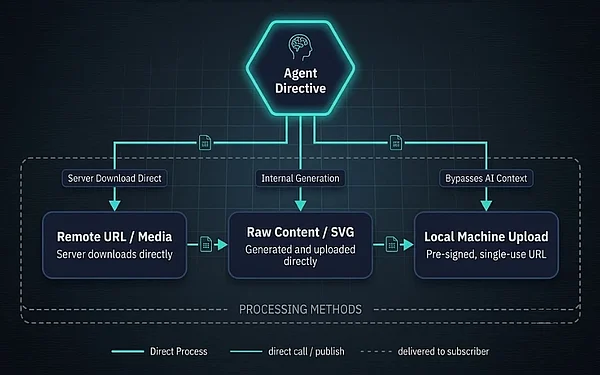
- From a Remote URL: The TYPO3 server downloads the asset directly, keeping tokens private.
- From Video Platforms: YouTube and Vimeo links resolve into native online media assets.
- Directly as Raw Content: Models generate SVG vector graphics or CSV tables and stream them straight into the file system.
- Local Machine Upload via Pre-signed URLs: Bypasses base64 overhead by issuing single-use, pre-signed upload URLs that transfer files out-of-band directly to authorized file mounts.
Security and Safety Considerations for TYPO3 MCP
The MCP architecture enforces strict enterprise guardrails: create-only file protection to prevent accidental live deletions, anti-SSRF download hardening against private IP ranges, blocking of executable scripts, and strict inheritance of the connected backend user's file and workspace permissions.
How PIT Solutions Supports AI-Powered TYPO3 Development
The union of TYPO3's rock-solid workspace architecture with the Model Context Protocol changes how modern digital teams operate. By turning TYPO3 into an accessible, tool-equipped runtime for AI models, teams can automate complex content curation, localization, asset management, and technical audits without sacrificing editorial control.
At PIT Solutions, we help global enterprises navigate this transformation through expert TYPO3 Solutions, Custom Web Development Services, Web Application Development Services, and advanced AI Development Services.
Ready to bring agentic AI capabilities to your CMS infrastructure? Get in touch with PIT Solutions today to discuss your project.

Azeef AS
Senior Project Manager
Azeef heads the TYPO3, web and mobile application development team. He has immense experience in handling the full development life cycle of software projects by working closely with clients in various web and mobile technologies.
He was one of the first TYPO3 certified integrators from INDIA. He has attended TYPO3 conferences (T3CON) held in Europe and had presented papers. PIT Solutions have a solid TYPO3 team under him and we are one of the official TYPO3 Solution Partners from INDIA.