


Cloud computing has revolutionised the business landscape, allowing for faster innovation, scalability and remote access to applications and data. Across industries, organizations are migrating critical workloads to cloud platforms to increase agility, reduce infrastructure costs and drive digital transformation.
But as more organizations move to the cloud, traditional security approaches can no longer fully protect modern business environments. The old way of thinking, of trying to keep everything inside a trusted network perimeter, doesn’t work very well when applications, users, devices, and data are scattered across cloud platforms.
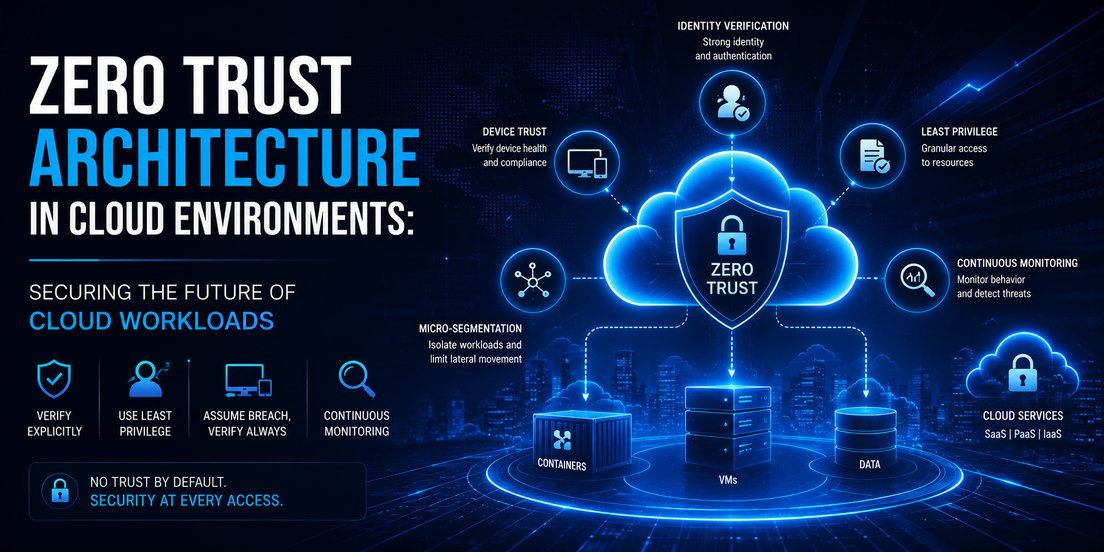
That’s where Zero Trust Architecture comes into play. Zero Trust is founded on the principle of “never trust, always verify” to make sure that every user, device, application and workload is continuously authenticated and authorised before access is granted.
Zero Trust is more than a security strategy for businesses running workloads in the cloud; it is a foundation for protecting sensitive data, preventing unauthorised access, and maintaining business continuity.
What Is Zero Trust Architecture?
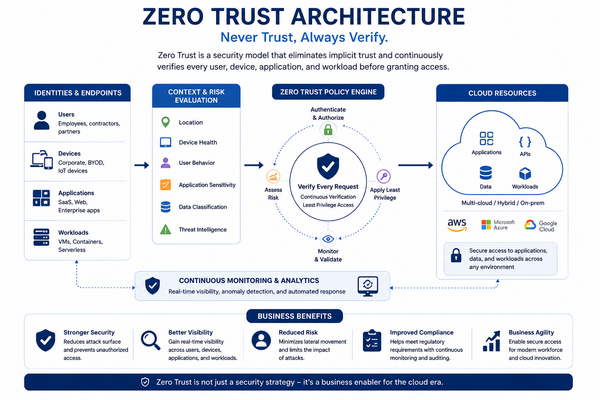
Zero Trust Architecture is a security model that aims to remove implicit trust from IT environments. Zero Trust demands continuous verification of every access request, rather than assuming that users or systems inside the network are automatically safe.
Zero Trust Architecture allows access in cloud environments based on identity, security posture, permissions, location, device health, and business requirements.
Zero Trust is based on three principles:
- Authentication of all access requests
- Least privilege
- Continuous monitoring of activities to detect abnormal activity.
This helps organizations reduce their attack surface and minimise impact of potential security incidents.
Why Zero Trust Is Important for Businesses Running Workloads on Cloud
Cloud environments are constantly changing. Employees use applications from multiple locations, organizations use multiple cloud services and applications communicate with each other through APIs and distributed systems. This flexibility also brings new security challenges.
In traditional data centers, security teams could control a defined network boundary, but in cloud environments, security is crucial wherever users, applications, workloads, and data exist.
Zero Trust assists businesses in overcoming these challenges by making security decisions based on verification, not just network location. Zero Trust controls limit attackers’ ability to freely move around the environment even if they gain access to one account or system.
Zero Trust adds a layer of security for organizations that handle sensitive customer data, financial data, intellectual property, or regulated workloads from modern cyber threats.
Key Components of Zero Trust Architecture
A good Zero Trust implementation is a suite of security controls that work together to protect cloud environments. The first step is identity verification. This process authenticates each user and workload prior to granting access. Least privilege access restricts access so users and applications can only access the resources they need to do their job.
Ongoing monitoring allows organizations to detect atypical behaviours and respond quickly to potential threats. With network segmentation, workloads are isolated and attackers cannot move freely around cloud environments in the event of a compromise. Cloud security is further enhanced by data protection measures such as encryption, security policies, and continuous compliance monitoring to protect sensitive information throughout its life cycle.
These elements together create a complete security framework that secures cloud workloads while enabling business agility and regulatory compliance.
Common Cloud Security Challenges Without Zero Trust Architecture
Organizations quickly adopt cloud services to support business growth, but security maturity does not always grow at the same pace. Without a structured Zero Trust approach, many security gaps can surface in a business.
Lack of Visibility Across Cloud Environments
With businesses using multiple cloud services, applications and remote access solutions, visibility becomes harder to maintain. IT teams often struggle to understand who is accessing resources, what permissions are in place, and whether cloud workloads are adequately protected. Poor visibility can let unauthorised access, misconfigurations and suspicious activities go undetected for longer periods of time.
Excessive Permissions and Identity Risks
In the world of cloud, identity has become one of the most critical security perimeters. However, many organizations find it difficult to manage user permissions effectively. Employees, applications and third-party services can be granted more access than they really need. If those accounts are compromised, attackers can take advantage of excessive privileges to reach sensitive systems and data.
Zero Trust mitigates this risk by implementing least privilege access and continuously verifying user and workload identities.
Complexity of Managing Cloud Security Controls
Cloud platforms have strong security capabilities but require specialised knowledge to configure and manage them. Organizations without dedicated cloud security expertise may have challenges with implementing access policies, monitoring, encryption, segmentation, and compliance controls efficiently.
This challenge is especially common for growing businesses that are adopting cloud technology, but don’t have large in-house security teams.
Challenges Faced by Non-Tech-Heavy Organizations in Implementing Zero Trust
Zero Trust can be a complex proposition for organizations lacking a strong technical foundation or dedicated cybersecurity teams. Businesses understand the importance of cloud security but often don’t know where to start.
Common issues include shortage of skilled cloud security professionals, low understanding of security frameworks, difficulty in selecting the right tools and lack of clarity about managing existing cloud environments.
In addition, adopting Zero Trust is not a one-time event. Zero Trust adoption requires continuous monitoring, policy enhancement, identity management and security tuning. Organizations without the right expertise may implement partial solutions that don’t provide the expected level of protection.
Zero Trust Across AWS, Azure, and Google Cloud
Zero Trust principles can be applied to all the major cloud platforms including Amazon Web Services (AWS), Microsoft Azure and Google Cloud Platform (GCP). All platforms have native security services and identity management capabilities, but the underlying Zero Trust principles are the same: continuous identity verification, least privilege access, monitoring user and workload behaviour, and protecting critical resources.
Organizations that run in a multi-cloud or hybrid environment also face the added challenge of maintaining consistent security policies across different cloud providers. Without a unified approach, security gaps and configuration inconsistencies can occur.
PIT Solutions helps organizations deliver consistent Zero Trust strategies across Azure, AWS, Google Cloud and hybrid environments. Our cloud security experts design security architectures for standardising access controls, centralised visibility, and continuous monitoring so that businesses can secure cloud workloads regardless of where they are hosted.
How Expert Cloud Security Services Help Businesses Adopt Zero Trust
Building a Zero Trust environment requires a combination of technology, processes, and security expertise. This is where experienced cloud security partners help bridge the gap between cloud adoption and secure operations for organizations.
At PIT Solutions, we help organizations design and deploy Zero Trust security strategies that align with their cloud environments, business objectives, and regulatory compliance requirements.
Our approach is understanding what is already in the cloud environment, where security gaps exist and the right controls are established in place to safeguard users, applications, workloads and data.
We help businesses build stronger identity management, access controls, cloud monitoring, security policies and threat protection mechanisms. This allows organizations of all sizes—from growing businesses to enterprise-level organizations—to run their cloud workloads securely without requiring deep expertise in-house.
Zero Trust Solutions for Businesses of Every Size
Zero Trust isn’t just for large companies. Cyber risks are on the rise as small and medium-sized enterprises move to cloud applications and remote work models.
For smaller organizations, Zero Trust provides the foundation of good security without the need for a large cybersecurity team. It helps large organizations manage complex environments with multiple clouds, applications, users, and business units.
A carefully crafted Zero Trust strategy can scale with the business, enabling organizations to embrace new technologies in a secure manner while still maintaining control of their digital assets.
Building a Secure Cloud Future with Zero Trust
As cloud adoption accelerates, security strategies must move beyond traditional defences. Organizations can no longer rely on firewalls or network perimeters to protect critical workloads.
Zero Trust Architecture provides a modern way to continuously validate access, reduce unnecessary privileges, and gain better visibility across cloud environments.
Zero Trust enables businesses to respond more effectively to the evolving cyber threat landscape while maintaining security, compliance and operational efficiency.
Conclusion: Strengthen Your Cloud Security with Zero Trust Expertise from PIT Solutions
Cloud security challenges are increasing as enterprises move more critical workloads to cloud platforms. Without a Zero Trust approach, organizations are at risk of unauthorised access, data exposure, compliance issues, and disruptions to operations.
It takes the right strategy, expertise and ongoing management to implement Zero Trust. Organizations without deep cloud security capabilities can address these challenges by partnering with experienced cloud security vendors.
PIT Solutions helps organizations establish secure cloud environments using Zero Trust principles, strengthened access controls, increased visibility, and protection of critical workloads.
Whether you’re new to the cloud or an enterprise with a complex cloud infrastructure, our cloud security expertise helps you move forward with confidence.
Zero Trust Your Way to Cloud Workload Security. Get in touch with our DevSecOps and cloud security experts today and develop a more robust, intelligent and resilient cloud security strategy.