Composable commerce is a modular approach to building e-commerce platforms, allowing businesses to select and integrate different technologies to create customized solutions. This flexibility enables quick adaptation to market changes and evolving customer needs, fostering innovation and providing a competitive edge.
In the fast-paced world of eCommerce, the demand for flexibility, scalability, and resilience is more crucial than ever. Traditional monolithic architectures, where the entire application
Cloud Native
This refers to software where development and delivery are hosted on the cloud. With the business’s constantly changing needs and demands, this model provides out-of-the-box solutions and doesn’t require frequent installation or maintenance. Updates and upgrades happen automatically without any customer effort, downtime, costs, or other fees. Hosting e-commerce on the cloud platform helps in scaling the business infinitely. In this way, cloud infrastructure provides sophisticated scaling capabilities to meet growing demands over time.
Benefits:
- Scalability: Easily scale resources up or down based on demand.
- Cost-Efficiency: Pay only for the resources you use, optimizing expenses.
- Resilience: Benefit from high availability and disaster recovery options provided by cloud services.
Implementation Steps:
- Choose a Cloud Provider: Select a provider like AWS, Azure, or Google Cloud based on your needs.
- Adopt Cloud Services: Utilize cloud-native services such as managed databases, serverless computing, and auto-scaling groups to enhance flexibility and efficiency.
- Automate Infrastructure: Implement Infrastructure as Code (IaC) tools like Terraform or AWS CloudFormation for managing and automating cloud resources.
- Monitor and Optimize: Use monitoring tools to track system performance and optimize the use of resources to ensure efficient operation.
Practical Use Cases of MACH in eCommerce
- Personalization: Utilize microservices for personalized recommendations based on user behaviour data.
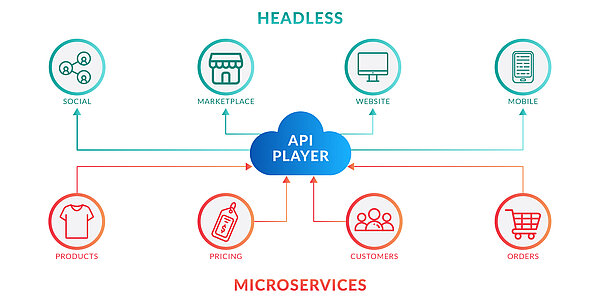
- Omnichannel Retail: Implement a headless architecture to provide a seamless shopping experience across online stores, mobile apps, and in-store kiosks.
- Scalable Promotions: Utilize cloud-native services to scale promotional campaigns during peak seasons, ensuring responsiveness under heavy traffic.
- Seamless Integrations: Use APIs to integrate with various third-party services such as payment gateways, shipping providers, and marketing tools.
Challenges and Considerations
- Complexity: Managing multiple microservices and ensuring smooth communication can pose challenges.
- Security: Secure APIs to safeguard functionalities against unauthorized access.
- Data Consistency: Ensure consistent data across microservices through meticulous planning.
- Cost Management: Effectively manage cloud resources to control and optimize costs.
Composable Commerce
MACH Architecture forms the foundation of Composable Commerce. Headlessness, a key aspect of MACH, marks the initial step towards achieving Composable Commerce.
Headlessness dismantles monolithic structures by separating frontend and backend functionalities, enabling them to operate autonomously and enhancing flexibility and agility. However, mere headlessness alone does not fully unlock the spectrum of benefits for modern commerce.
Moving towards composable commerce involves advancing to the next level, where the focus shifts to assembling the customer experience by integrating components like cart, checkout, and order management from diverse vendors. Each component retains independent customization and replacement capabilities, catering precisely to desired customer experiences.
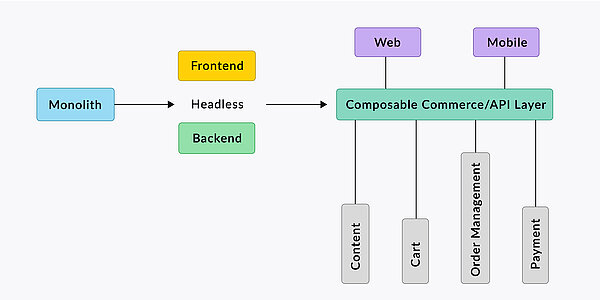
Thus, the principles of Composable Commerce align closely with the MACH architecture.
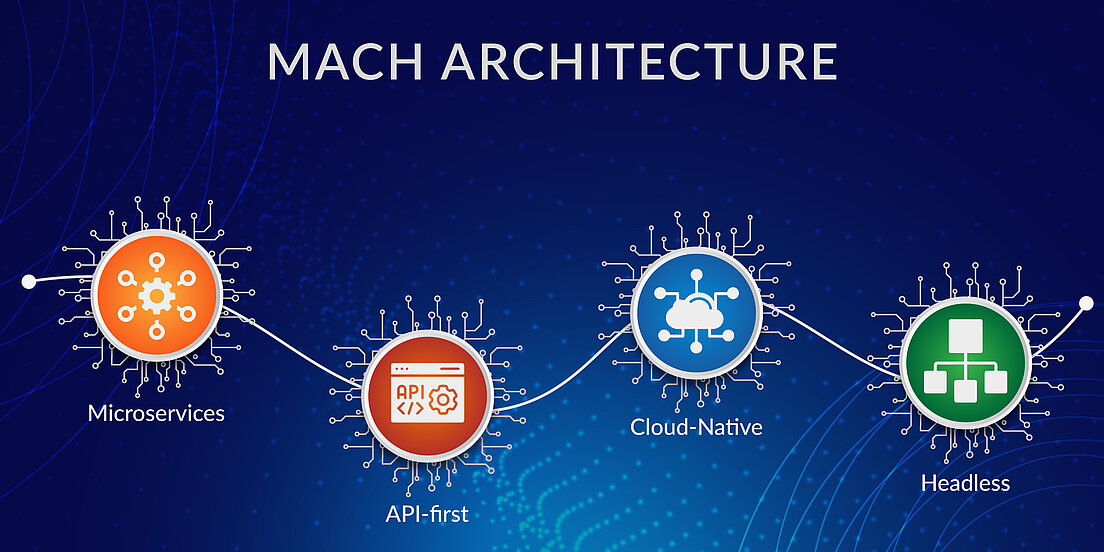
In a microservices architecture, the entire eCommerce solution is divided into smaller, manageable services that can be individually scaled and managed as needed.
The API-first approach ensures seamless communication between components, even if they are developed by different vendors.
The cloud-native aspect allows businesses to develop and deploy their entire eCommerce solution on any cloud platform, enhancing scalability, security, and reliability.
Closely related to the cloud-native approach is the SaaS model, where applications are hosted online and automatically kept up to date.
A headless approach involves decoupling the frontends from the backends, laying the foundation for a modular architecture that is essential for composability.
Conclusion
In summary, the MACH architecture offers a robust framework for constructing eCommerce platforms in a modular way, adeptly managing the complexities and rapid changes of the digital marketplace. By incorporating microservices, an API-first approach, cloud-native infrastructure, and headless architecture, businesses can achieve:
- Scalability: The capability to expand and efficiently manage increased traffic and workloads.
- Flexibility: The agility to adopt new technologies and meet customer demands swiftly and effectively.
- Resilience: The ability to sustain functionality even when individual components fail.
-
Efficiency: Enhanced operations and streamlined development processes, facilitating faster innovation and deployment.
Adopting the principles of Composable Commerce through MACH architecture enables eCommerce businesses to deliver exceptional customer experiences, respond quickly to market trends, and maintain a competitive edge in the continuously evolving digital landscape.

Sanjay KS
Sanjay Kumar is a skilled SAP Commerce (Hybris) Developer with over four years of experience in e-commerce development and system integration. He possesses a strong background in SAP Commerce Cloud and Java, with expertise in payment gateway integrations and scalable enterprise solutions. He has extensive experience managing the complete software project development lifecycle and collaborates closely with clients to deliver customized, high-quality solutions. He holds SAP Commerce Cloud and Java certifications, demonstrating his technical proficiency and commitment to continuous learning.