




Importance of Data Archival
As you all know that, there is an exponential rise in the amount of data being generated by organizations. One of the most important aspects of managing a business today is managing its data growth. On a daily basis, the
cost of data management outpaces the data storage costs for most organizations. Data that does not have any current requirement or usage, known as inactive data, can be archived to a safe and secure storage.
Data archiving becomes important for companies who want to manage their data growth, without compromising on the quality of data that resides in their production systems.
“Data Archival is the process of moving data that is not required for operational, analytical or reporting purposes to offline storage”
A data retrieval mechanism is developed to restore data from the offline storage.
Data Archival Testing –Planning and Implementation
Common challenges during data archival are:
- Inaccurate or irrelevant data in data archives
- Difficulty in the data retrieval process from the data archives
Data archival testing address these challenges. While devising the data archival test plan, the following factors need to be taken into consideration:
- Data Dependencies
Data archival testing need to validate that all related data is archived together for easy interpretation, during storage and retrieval.
- Data Encoding
Encoding of data in the archival database depends on the underlying hardware for certain types of data. Data archival testing needs to ensure that the encoding of numerical fields such as integers also archives the related hardware information, for easier future data retrieval and display of data with a different set of hardware.
- Data Retrieval
Data need to be retrieved from archives for regulatory, legal and business needs. The validation of the data retrieval process ensures that the archived data is easily accessed, retrieved and displayed in a format which can be clearly interpreted without any time consuming manual intervention.
Data Archival testing process includes Data archival, Data deletion &Data retrieval
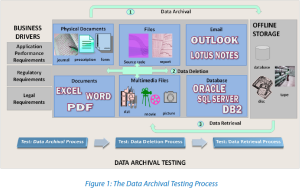
- Test the Data Archival Process
- Testing the Data Archival process ensures that business entities that are archived includes master data, transaction data, Meta data and reference data.
- Validates the storage mechanism and that the archived data is stored in the correct format. The data also has to be tested for hardware independence.
- Test Data Deletion Process
- Inactive data needs to be archived and moved to a secure storage for retrieval at a later point and then deleted from all active applications using it. This validation process would verify that the test data deletion process has not caused any error to any existing applications and dashboards.
- When archived data is deleted from systems, verify that the applications and reports are conforming to their performance requirements
- Test Data Retrieval process
- Data that has been archived needs to be easily identified and accessible in case of any legal or business needs.
- For scenarios that involve urgent data retrievals, processes for the same need to be validated within a defined time period.
Benefits of Data Archival Testing
- Reduced storage costs
Only the data that is relevant gets archived and for a defined time period which reduces hardware costs and its maintenance costs significantly.
- Minimize business outages
Archived data that is deleted from production does not have an impact on the related applications’ performance and functionality, leading to smooth business operations.
- Improved Application Performance
Data is retrieved faster; the network performs better as only relevant data is present in the production environment. All these factors enhance application performance.
- Data compliance
Easy retrieval and availability of archived data ensures higher data compliance with the legal and regulatory requirements.